00:01
MAN: I just I don’t understand.
00:03
WOMAN: Of course you don’t, Justin. And that’s why I’m breaking up with you!
00:07
MAN: I don’t get it.
00:09
WOMAN: You’re not listening to me!
00:17
MAN: Sorry, can you repeat that?
00:26
BILL NYE: What we have here is a failure to communicate.
00:32
Pull up to the lab,
It’s been a minute
‘The Science Guy’ is back
With a special mission
00:38
Friedreich ataxia?
It’s a rare disease
If you think that’s you
Let’s get up to speed
00:42
Back in the lab, back in the lab,
Back in the lab with Bill Nye
Hi Bill, hi Bill, hi!
00:52
THE VOICE: Bye Bill.
00:54
BILL NYE: Communication. Nothing works without it.
00:57
THE VOICE: I heard that in therapy.
00:59
BILL NYE: Our nervous system is a network of pathways (car SFX) that communicates between the brain and muscles. But with Friedreich ataxia, there’s a communication breakdown (mechanic SFX). Please, consider the following.
01:15
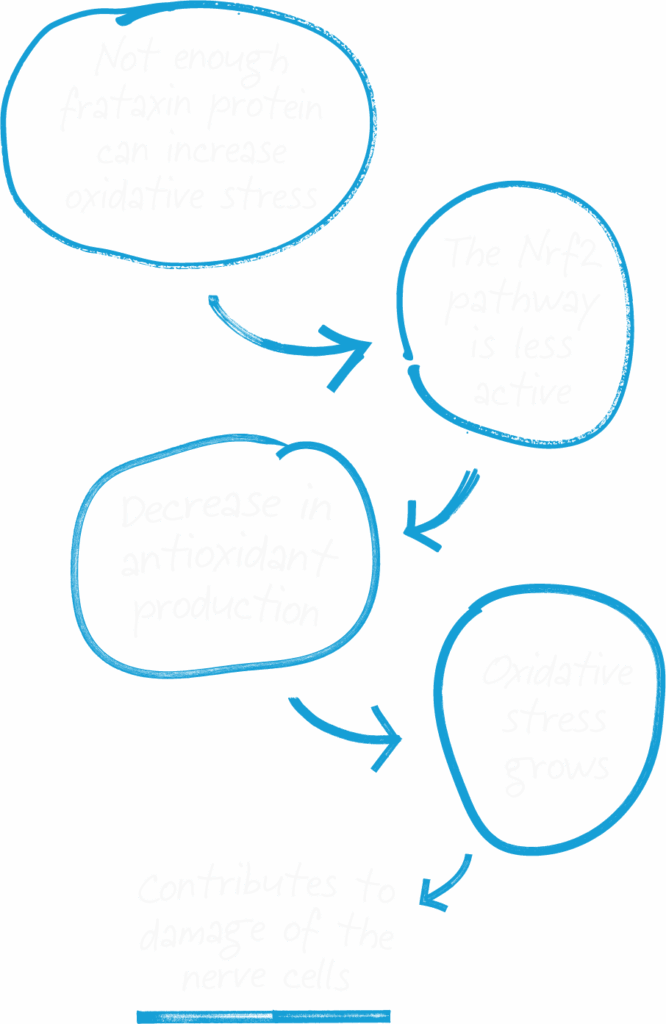
BILL NYE: Today, we’re looking at the impact of oxidative stress on the nervous system. Say, Christian, why is the system so nervous?
01:25
CHRISTIAN: Well, actually a reduction in frataxin leads to a build-up of oxidative stress, that causes a lot of cell damage, specifically in areas like the spinal cord and the peripheral nerves.
01:40
BILL NYE: Hmm. So, first, let’s look at the nervous system that’s working properly. This steel wool is the neural pathway that connects the brain to the spine.
01:51
BILL NYE: Now, let’s see what happens when we add oxidative stress.
02:02
BILL NYE: Well, I mean, it takes time. If this were a cooking show, I’d say, here’s one I prepared earlier.
02:11
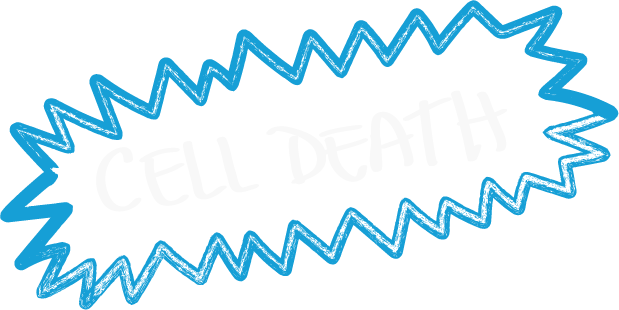
BILL NYE: You see, too much oxidative stress damages nerve cells, impacting communication between the brain and the rest of the body.
02:23
PUPPET BRAIN: Hello, Spinal Cord!
02:25
PUPPET SPINAL CORD: Hey, Brain!
02:26
PUPPET BRAIN: So, what are you up to today?
02:27
PUPPET BILL: As Friedreich ataxia progresses, communication continues to break down in different parts of the body–like this.
02:41
PUPPET BRAIN: Hey, what’s the big idea!?
02:44
PUPPET SPINAL CORD: Big ears? What the what? I don’t have ears!
02:45
PUPPET BILL: When your nerve cells are damaged and aren’t communicating well, you’ll notice your symptoms getting worse–more clumsy movements, slurred speech, and so on. It’s important to note that everyone is different. It may happen faster or slower for some people.
03:00
PUPPET SPINAL CORD: I bet you think you’re soooo smart.
03:05
PUPPET BRAIN: You’ve got a lot of nerve, buddy!
03:07
PUPPET SPINAL CORD: You bet I do.
03:08
PUPPET BRAIN: I’m the brain. I’m in control. Without me you’d be NOTHING!
03:21
BILL NYE: Remember, the cells in our body have to talk to each other to function properly.
03:25
BILL NYE: But as Friedreich ataxia progresses, damage to cells causes a communication breakdown. That’s why, no matter how slow or fast you think your symptoms are progressing, you should talk to your doctor.
03:46
BILL NYE: Hey! Why can’t I connect?
03:49
THE VOICE: Sorry, I was calling my mom.
03:51
BILL NYE: Oh, that figures. Kids today.
03:59
PUPPET BRAIN: You can’t control me! Wait a minute that’s not the line in the slightest. It’s like I never even read this script. I’m a failure!
04:09
BILL NYE: There’s a communication breakdown. Please…oh boy went a little too far.
04:15
PUPPET BRAIN: Nothing I tell you, I tell you again nothing! Not one single thing!
04:22
PUPPET SPINAL CORD: Help meeeeee!
04:25
BILL NYE: Pre-circle! Purple sharpie!
04:27
PUPPET BRAIN: Don’t make me come over there and start solving algorithmic equations with the slide rule!