

Written by Dr. Pragya Goel
Edited by Dr. Lauren Moore
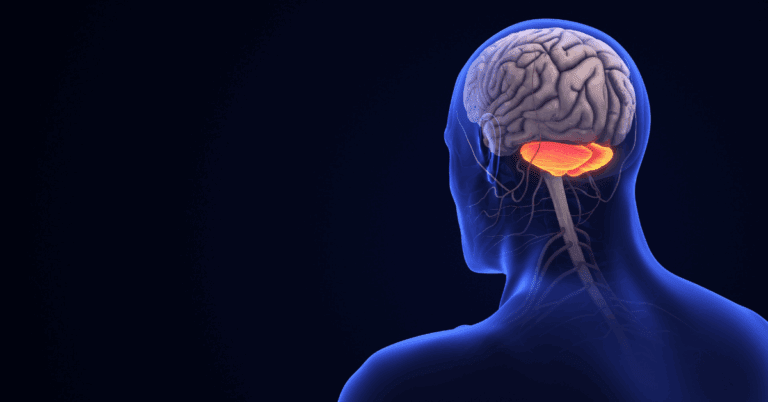
Research in mice shows that a specific cell population in the cerebellum maintains balance as we age.
Falls due to imbalance are common and dangerous in the elderly, but what exact changes in the brain are responsible for this is unclear. Balance and spatial orientation are controlled by the vestibular system comprised of the inner ear with other brain regions particularly the cerebellum. Reduced overall function of this system is a known major cause of age-related decline in balance. In this recent study, Kizeev and colleagues zero in on the exact group of brain cells in the cerebellum called Unipolar Brush Cells (UBCs) that may help us stay balanced as we age. Researchers impaired the function of UBCs in young and old mice and observed what happened to the animals’ ability to balance. Surprisingly, older animals had more difficulty staying balanced compared to young mice when UBCs were impaired. Discovery of these cells in balance performance provides a new potential target to develop therapeutic strategies for age-related balance issues that result in injury and disability in the elderly.
The cerebellum is composed of a network of three major cell types: Purkinje cells, granule cells and UBCs that together control balance and coordination. In many forms of ataxia, it is long known that Purkinje cells malfunction or degenerate, which likely leads to imbalance and incoordination that worsens with age. Disrupting granule cell activity has no major effect on balance. However, UBCs are different. Previous studies have shown that when they are impaired, animals have trouble staying balanced. This suggests that UBCs may be an important piece of the puzzle for understanding and treating imbalance – a major symptom in ataxias.
But could UBCs also be responsible for our increased unsteadiness and instability as we age? This study specifically tests their role in this age-related balance performance. Aged (six-month-old) and young (seven-week-old) mice were put through a series of established motor tests that evaluated their ability to balance and make coordinated movements. These included a rotorod test (a rotating rod on which mice try to keep up), a balance beam test (an aluminium rod on which animals are tested to walk and balance), and a swimming test (animals are put in a cylinder of water to analyze movement dynamics). Without UBC disruption, young mice outperformed older ones in all balance tests, supporting the notion that balance is impaired in old mice. Next, using a sophisticated technique, UBC activity was disrupted and aged and young mice were put through the same three motor tests. Interestingly, older mice with impaired UBCs performed worse than those with normal UBC function, while the balance performance of young mice was similar with or without UBC disruption. Thus, UBCs play a key role in maintaining balance as animals get older but are seemingly less important in younger mice.
In summary, when scientists disrupted a group of brain cells called UBCs in mice, older animals displayed poor balance but not younger ones. Researchers speculated that a higher flexibility of younger brains may enable them to adjust and compensate by modulating activity of other cell types, when one group of cells (UBCs in this case) is not functioning properly. This compensating ability could be lost as animal age, worsening balance behaviors. “Balance” is a broad and general term, and the three tests enable assessment of different aspects of balance. The researchers also found that certain balance behaviors were more significantly affected highlighting how these UBCs may be responsible for nuanced balance processing. Narrowing in on specific brain cells as opposed to general cell populations and brain regions has the potential to guide basic and clinical research on targeted therapies. In the future, scientists might be able to target UBCs to help prevent falls and improve mobility in older adults. While further research is required, this study is an exciting step forward.
Conflict of Interest Statement
The author and editor have no conflicts of interest to declare.
Citation of Article Reviewed
Kizeev., et al., Balance Performance in Aged Mice is Dependent on Unipolar Brush Cells. Cerebellum, 2024. 24 (1) :16. (https://pubmed.ncbi.nlm.nih.gov/39699796/ )
Read Other SCAsource Summary Articles

An imbalance in balance with age? How a subpopulation of nerve cells may help us stay steady
Written by Dr. Pragya Goel Edited by Dr. Lauren Moore Research in mice shows that a specific cell population in the cerebellum maintains balance as we age. Falls due to Read More…

Snapshot: ¿Qué es la Arreflexia?
Snapshot escrito por: Lin (Summer) Dong Editado por: Sharan Srinivasan, MD Traducido por: Ismael Araujo Aliag La arreflexia, proveniente de la palabra griega “a”, que significa ausencia, es una condición médica caracterizada por la ausencia o reducción de los reflejos. Los Read More…

24/7 Wearable Sensors: A New Way to Track Ataxia
Written by Poojashree Chettiar Edited by Pragya Goel, PhD AI and wearable tech may transform how ataxia is monitored Could everyday devices help track ataxia? Finding treatments for neurological disorders Read More…