
Our DNA (deoxyribonucleic acid) serves as a genetic blueprint for building and maintaining our tissues. This complex molecule contains the information needed to build proteins, written in a code made up of four chemical bases: adenine (A), thymine (T), cytosine (C) and guanine (G). During transcription, the DNA sequence—stored in the cell’s nucleus—is copied into another complex molecule called messenger ribonucleic acid (mRNA). This mRNA molecule then serves as a template for protein synthesis, carrying the genetic instructions from the nucleus to cellular machinery called ribosomes, where proteins are assembled.
Sequences of three bases, called codons, specify particular amino acids—the building blocks of proteins. Amino acids are linked together in a specific order to form long chains. These chains fold into proteins, with their complex three-dimensional shapes determined by the amino acid sequence. Click here to learn more about the relationship between DNA, mRNA, amino acids and proteins.
Even small changes in the amino acid sequence can have a dramatic impact on protein structure and function.
Point Mutations
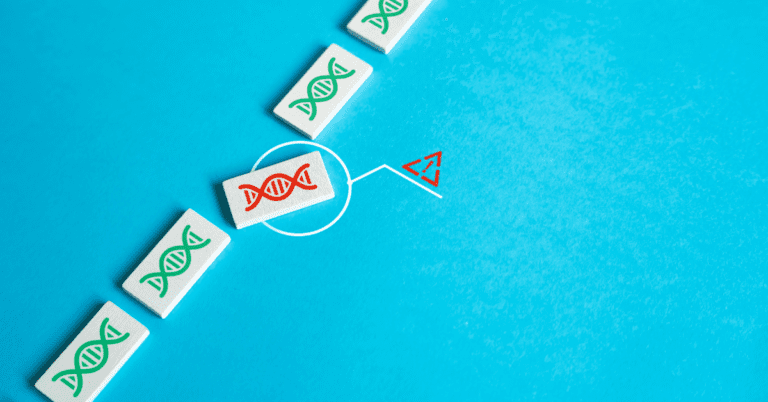
Occasionally, a single chemical base in our DNA is altered, resulting in the coding of an incorrect amino acid and, in turn, atypical protein production. This type of mutation is called a point mutation—the term “point” reflects the specific, isolated nature of the change in the DNA sequence.
Point mutations can be further categorized as missense, nonsense or silent mutations.
Missense Mutations - Swapping One Amino Acid for Another
In missense mutations, a change in one chemical base within the DNA sequence results in the substitution of one amino acid for another during protein production.
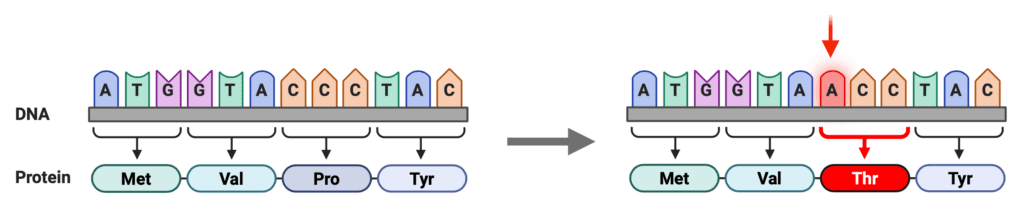
For example, the DNA sequence illustrated below contains the codon CCC, which codes for the amino acid proline (Pro). A missense mutation affecting the first chemical base in this codon may result in a new codon—ACC—which codes for the amino acid threonine (Thr). This seemingly minor change in DNA sequence can have significant consequences, especially if the originally intended amino acid proline plays a crucial role in the structure and function of the protein coded by the larger gene sequence.
Figure made by Larissa Nitschke using BioRender.org.
Missense Mutations and Spinocerebellar Ataxia
Many forms of spinocerebellar ataxia (SCA) have been linked to missense mutations, particularly in genes that encode proteins critical for neuron signalling and communication. These mutations ultimately disrupt neuron function, leading to various neurological symptoms.
For instance, SCA29 has been linked to missense mutations in the ITPR1 gene, which encodes a protein called inositol 1,4,5-trisphosphate receptor type 1. This protein is highly expressed in Purkinje cells, a type of neuron in the cerebellum, and is critical for their function. Similarly, SCA11 has been linked to missense mutations in the TTBK2 gene, which encodes the tau tubulin kinase 2 protein. This protein is critical for Purkinje cell connectivity and communication. Missense mutations in each of these genes disrupt Purkinje cell function and ultimately lead to cerebellar dysfunction. Missense mutations have also been linked to SCA5, SCA15 and SCA23, among others.
The variety of missense and other gene mutations linked to SCA tells us that the condition can result from disruptions in a wide range of cellular pathways. Identifying these mutations is an important step toward fully understanding SCA and developing new treatments.
If you would like to learn more about missense mutations, take a look at these resources by Osmosis.org and the National Human Genome Research Institute.
Written by Dr. Chloe Soutar and edited by Dr. Larissa Nitschke.
Read Other SCAsource Snapshot Articles

Snapshot: What Are Missense Mutations?
Our DNA (deoxyribonucleic acid) serves as a genetic blueprint for building and maintaining our tissues. This complex molecule contains the information needed to build proteins, written in a code made Read More…

Snapshot: What is FGF14?
FGF14 or fibroblast growth factor 14 is an essential protein found predominantly in the brain, specifically in Purkinje cells. These brain cells are responsible for maintaining everyday functions such as Read More…
Snapshot: ¿Qué es una Mutación De Novo?
Para que nuestro cuerpo funcione de manera saludable, es necesario llevar a cabo muchos procesos celulares esenciales regulados por moléculas creadas en nuestro interior. Esta molécula base es llamada ADN, Read More…