


Written by Jacen Emerson
Edited by Hannah Shorrock, PhD
Human Imaging data reveals worsening spinal cord damage in several Ataxias that can begin before symptoms start.
Why does the spinal cord matter in SCA?
Rezende and colleagues recently published the most thorough study of spinal cord damage in Spinocerebellar Ataxias (SCAs) to date. Their study used Magnetic Resonance Imaging (MRI) data from patients with the most common SCAs: SCA1, SCA2, SCA3, and SCA6. The data showed that there is spinal cord damage in SCA1, SCA2 and SCA3. Further, this damage can be seen before patients show disease symptoms in SCA1 and SCA3. These findings support previous work and may drive more research in the spinal cord in SCAs that could improve our understanding of the diseases and our ability to develop effective treatments.
SCAs are a group of genetically inherited diseases that affect a patients balance and overall ability to move. The different subtypes of SCA studied by Rezende and colleagues have different genetic causes but lead to similar movement disorders. Prior work on SCAs has shown specific brain regions are damaged in these diseases and responsible for the symptom’s experienced by a patient with SCA. It has been suggested that the spinal cord may be damaged in some SCAs, but this region has not been studied as much as different brain regions. It is essential to understand if the spinal cord is affected in these diseases as it plays a key role in the normal process of human movement that is affected in SCAs. Research on the spinal cord as in this paper could help uncover new features of SCA that could be used in the search for effective therapies for these diseases.
Measuring spinal cord damage
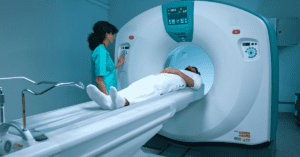
In this study scientists used MRI to measure spinal cord damage in patients with SCA. MRI is a non-invasive method of data collection that takes a three-dimensional picture inside the body and allows for accurate measurements of organs such as the spinal cord. In this study the authors were interested in looking at pictures of the top of the spinal cord where it connects to the brain in SCA patients and healthy control subjects. This region of the spinal cord is known as the cervical spinal cord. With these pictures Rezende and colleagues made two main measurements. First is the Cross-Sectional Area (CSA): this is the average area of the spinal cord in two dimensions down its length. If the spinal cord area is smaller, it may not contain all the biological machinery needed to function properly. We can say a smaller spinal cord is due to damage caused by the disease. The second measure used in this study is the eccentricity: this is the average roundness of the spinal cord. The spinal cord should be approximately oval shaped. If the spinal cord is flattened, it is likely because pieces normally inside are missing. This can also indicate damage that may cause disease symptoms.
Looking at the overall spinal cord area patients with SCA1, SCA2 and SCA3 had smaller spinal cords than control patients. This suggests there is damage to the tissue in these diseases. To further understand this damage, MRI was performed on pre-ataxic patients and patients at several stages of disease progression. By comparing the area of the spinal cord at different stages of disease the authors found that 1) the spinal cord is damaged in these diseases before patients experience their first symptoms and 2) the spinal cord gets more and more damaged the longer a patient has had the disease. Patients with SCA6 had a normal cervical spinal cord area at all stages of disease measured, indicating it is not damaged in these patients.
The eccentricity data showed that patients with SCA1, SCA2 and SCA3 had flattened/damaged spinal cords when compared to healthy controls. When measuring eccentricity at different stages of disease there were slight differences found. Patients with SCA1 and SCA3 showed this type of spinal cord damage starting before symptoms began, but the damage did not significantly worsen with time. Patients with SCA2 showed less of this damage early in disease, but their spinal cords got flatter and flatter over time. Again, patients with SCA6 did not show this type of spinal cord damage compared to healthy controls.
Spinal cord area as a potential biomarker for SCAs
One exciting contribution of this work is a potential biomarker for SCAs. A biomarker is a non-invasive measure (such as an MRI) that can provide a snapshot of a patient’s current disease status and possible trajectory. Biomarkers are important for clinical trials of new SCA treatments as they can quickly show if a patient is getting better and measure how much better they are getting. The SCA field is currently lacking effective biomarkers, which are incredibly important for clinical trial design and outcomes and could also help drive the search for therapies. Since spinal cord area was found to be reduced in SCA patients before symptoms begin, and to worsen overtime, it could provide a good biomarker for these diseases.
The clinical implications of spinal cord damage in SCA
Without molecular studies it is hard to pinpoint exactly what clinical symptoms may be caused by the overall reduced area of the spinal cord measured in SCA1, SCA2, and SCA3. What the authors did instead is compare the spinal cord area with a patients Scale for Assessment and Rating of Ataxia (SARA) score. By comparing their data with the overall severity of disease they were able to conclude that there is a significant relationship between spinal cord area and SARA score. This means that as a patient’s spinal cord becomes more damaged their ataxia symptoms are worsening.
The eccentricity changes seen in SCA patients can be more closely related to specific clinical symptoms based on previous research on this type of damage. Past research has related a flatter spinal cord to sensory abnormalities known as neuropathy. Neuropathy is a condition where patients experience either numbness or hypersensitivity and pain in their hands and feet. Patient stories and recent research have begun to investigate neuropathy in SCAs, a symptom that could be related to the spinal cord damage seen here. Overall, the findings in this paper support further research in the spinal cord in SCAs as it likely contributes to disease and may provide new ideas about how the disease works.
Key Words
Magnetic Resonance Imaging (MRI): A form of imaging that allows doctors and researchers to see a human’s internal organs. Produces a 3-D picture of the target area that can be used to make measurements and diagnoses.
Eccentricity: How circular a round shape is. The larger the eccentricity, the more oval-like and flat the shape.
Conflict of Interest Statement
The author and editor have no conflicts of interest to declare.
Citation of Article Reviewed
Rezende TJR, et al. Genotype specific spinal cord damage in spinocerebellar ataxias- an ENIGMA-Ataxia study. J Neurol Neurosurg Psychiatry. February 21, 2024. 95: p.682-690. (https://pubmed.ncbi.nlm.nih.gov/38227368/)
Read Other SCAsource Summary Articles

Snapshot: ¿Qué es la Arreflexia?
Snapshot escrito por: Lin (Summer) Dong Editado por: Sharan Srinivasan, MD Traducido por: Ismael Araujo Aliag La arreflexia, proveniente de la palabra griega “a”, que significa ausencia, es una condición médica caracterizada por la ausencia o reducción de los reflejos. Los Read More…


24/7 Wearable Sensors: A New Way to Track Ataxia
Written by Poojashree Chettiar Edited by Pragya Goel, PhD AI and wearable tech may transform how ataxia is monitored Could everyday devices help track ataxia? Finding treatments for neurological disorders Read More…
Spinal Cord Damage Detected Prior to Disease Onset in Several SCAs
Written by Jacen Emerson Edited by Hannah Shorrock, PhD Human Imaging data reveals worsening spinal cord damage in several Ataxias that can begin before symptoms start. Why does the spinal Read More…