

Our DNA (deoxyribonucleic acid) serves as a genetic blueprint for building and maintaining our tissues. This complex molecule contains the information needed to build proteins, written in a code made up of four chemical bases: adenine (A), thymine (T), cytosine (C) and guanine (G). During transcription, the DNA sequence—stored in the cell’s nucleus—is copied into another complex molecule called messenger ribonucleic acid (mRNA). This mRNA molecule then serves as a template for protein synthesis, carrying the genetic instructions from the nucleus to cellular machinery called ribosomes, where proteins are assembled.
Sequences of three bases, called codons, specify particular amino acids—the building blocks of proteins. Amino acids are linked together in a specific order to form long chains. These chains fold into proteins, with their complex three-dimensional shapes determined by the amino acid sequence. Click here to learn more about the relationship between DNA, mRNA, amino acids and proteins.
Even small changes in the amino acid sequence can have a dramatic impact on protein structure and function.
Point Mutations
Occasionally, a single chemical base in our DNA is altered, resulting in the coding of an incorrect amino acid and, in turn, atypical protein production. This type of mutation is called a point mutation—the term “point” reflects the specific, isolated nature of the change in the DNA sequence.
Point mutations can be further categorized as missense, nonsense or silent mutations.
Silent Mutations - Hidden Changes in the DNA Sequence
A silent mutation occurs when a base in the DNA sequence is changed, but this change does not alter the resulting amino acid sequence. Amino acid sequences can remain unchanged despite point mutations due to redundancy in the genetic code—multiple codons specify the same amino acid.
For example, the amino acid leucine is encoded by six codons: UUA, UUG, CUG, CUU, CUC and CUA. In a DNA sequence that normally specifies the codon CUC, a point mutation might result in the inappropriate presence of CUA, but the corresponding amino acid will still be leucine, as originally intended. Because the amino acid sequence is intact, the mutation is considered silent.
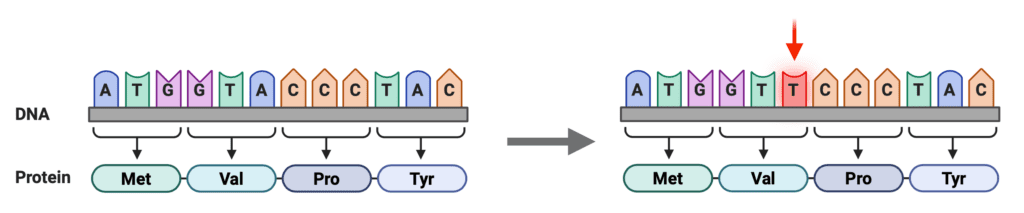
In the DNA sequence illustrated below, the codon GTA has been altered by a point mutation affecting the third chemical base, resulting in the codon GTT. Although the codon has changed, the resulting amino acid remains the same—valine (VAL).
Figure made by Larissa Nitschke using BioRender.org.
Not as “Silent” as Once Thought
At first glance, silent mutations seem harmless, but they can have far-reaching consequences. Historically, silent mutations were thought to have no effect on proteins, because they do not alter amino acid sequences; however, we now know that these mutations can affect the production of proteins in several ways. For example, silent mutations can reduce the stability of mRNA, limiting protein production and disrupting protein folding. These mutations can also change the rate at which mRNA is translated into proteins, resulting in too much or too little of a particular protein.
Silent Mutations and Spinocerebellar Ataxia
Silent mutations do not cause spinocerebellar ataxia (SCA), but they may contribute to the condition in several ways. By altering gene expression, protein synthesis or even interactions among proteins, silent mutations may influence an individual’s susceptibility to SCA, as well as the age of onset, severity and progression of their symptoms. Because silent mutations can modify these and other disease factors, we must consider them in our view of the overall genetic landscape of SCA.
If you would like to learn more about silent mutations, take a look at these resources from Britannica and Penn State.
Written by Dr. Chloe Soutar and edited by Dr. Larissa Nitschke.
Read Other SCAsource Snapshot Articles

Snapshot: What Are Silent Mutations?
Our DNA (deoxyribonucleic acid) serves as a genetic blueprint for building and maintaining our tissues. This complex molecule contains the information needed to build proteins, written in a code made Read More…


Snapshot: What is a Variant of Uncertain Significance (VUS)?
What is a variant? The human genome contains over 3 billion base pairs– individual “letters” in the DNA code that make the instructions for our cells and bodies to function. Read More…
Snapshot: What Are Nonsense Mutations?
Our DNA (deoxyribonucleic acid) serves as a genetic blueprint for building and maintaining our tissues. This complex molecule contains the information needed to build proteins, written in a code made Read More…