

Now Accepting Letters of Intent for 2027 Research Grants! Explore Funding Opportunities
This is a visual tool created to show the progress of SCA3 therapies that are currently being developed. Along the right side of the diagram, treatments are grouped by their mechanism, or how the drug works. The top of the diagram shows the stage of research where the drug is in development. Phases 1 through 3 involve clinical trials with human participants. Visit our PrepRARE: Clinical Trial Readiness Education page to learn more about each phase.
Once clinical trials provide enough evidence to prove that the drug is safe and effective, the sponsor of the drug can apply for regulatory approval of the drug. After regulatory approval, the drug can become available to individuals through their healthcare provider.
The agency responsible for reviewing and approving new treatments varies depending on where you are in the world. Some regulatory agencies include:
You can click the links above to learn more about each regulatory agency. This includes information about how they approve new medications.
Please note that a drug’s status is subject to change. Please visit clinicaltrials.gov for the most current information available for specific therapies. Detailed information is available for some of the drugs listed.
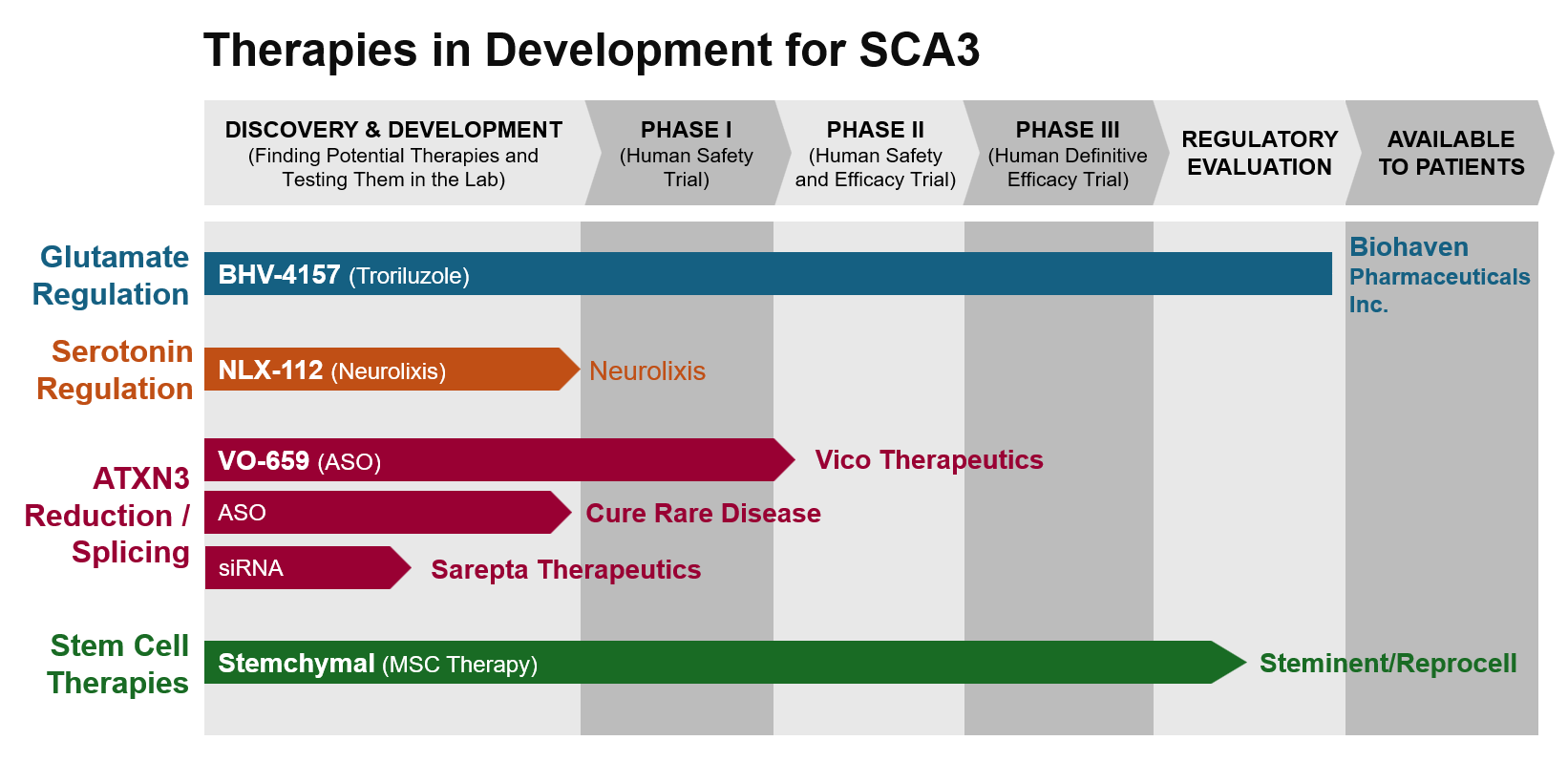
Troriluzole (BHV-4157, Biohaven Pharmaceuticals Inc.) is an oral prodrug formulation of Riluzole, a drug approved to treat ALS. Troriluzole helps to reduce glutamate dysfunction in the brain, which is a common symptom for many forms of ataxia. Controlling the amount of glutamate in the brain aims to improve ataxia symptoms.
Troriluzole is currently under review by the FDA to treat Spinocerebellar Ataxia (SCA).
NLX-112 (Neurolixis) is an investigational serotonin regulation therapy. NLX-112 binds to serotonin 5-HT1A receptors, which aims to improve motor symptoms in SCA3.
VO-659 (Vico Therapeutics) is an investigational antisense oligonucleotide (ASO) therapy. It targets the mutated CAG repeat expansions in ATXN3 mRNA. This reduces the amount of mutated ATXN3 protein, which aims to halt or slow disease progression.
Cure Rare Disease is developing an antisense oligonucleotide (ASO) therapy for SCA3. It targets the mutated CAG repeat expansions in ATXN3 mRNA. This reduces the amount of mutated ATXN3 protein, which aims to halt or slow disease progression.
Sarepta Therapeutics is developing an siRNA therapy for SCA1 and SCA3. This work is currently preclinical.
Stemchymal (Steminent/Reprocell) is an investigational mesenchymal stem cell therapy. Stem cells from healthy donors are extracted, then modified in the lab, before being used to treat people with SCA3 and SCA6. Stemchymal aims to treat ataxia symptoms by improving cell-to-cell communication, reducing inflammation, and potentially repairing tissue.
BioMarin Pharmaceutical Inc. is developing an antisense oligonucleotide (ASO) therapy for SCA1 and SCA3. This work is currently preclinical.
To learn more about participating in research visit our PrepRARE Clinical Trial Readiness Education page.