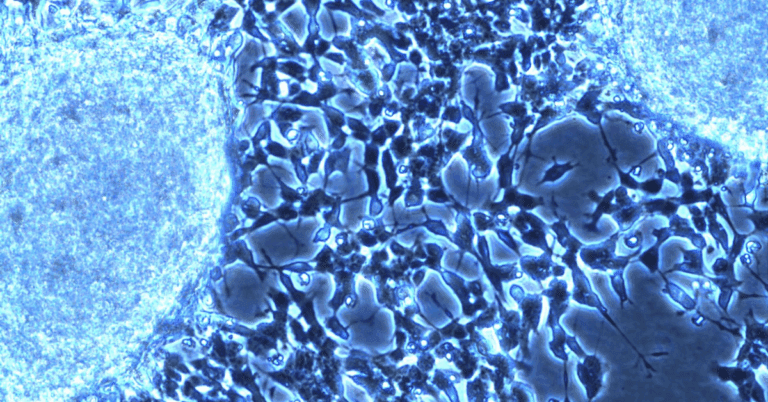
To develop treatments for human diseases such as spinocerebellar ataxia type 1 (SCA1), researchers need models that reflect how important processes go wrong at the molecular level in these diseases. Recently, scientists have created a new cell-based model of SCA1, which has led them to uncover exciting clues about this disease.
The group of researchers created a new cell-based model of SCA1 by inserting the human SCA1-causing ATXN1 gene into human neuron-like cells (called SH-SY5Y cells). In SCA1, the ataxin-1 protein contains an unusually long chain of the amino acid glutamine, and this mutant ataxin-1 protein forms clumps called ‘intranuclear inclusion bodies’ inside of neurons (brain cells). Just like in the neurons of people living with SCA1, scientists found that these new SCA1 cells also develop such clumps. These clumps are toxic and contribute to the death of neurons in SCA1, however, scientists do not know exactly what makes these clumps toxic to neurons because they are difficult to extract from cells, and the material found inside of them can vary. The scientists therefore created a new method for extracting these toxic clumps from cells to study them. Excitingly, they discovered that the clumps contain an unexpected molecule – RNA – providing new clues into the biological processes that malfunction in SCA1.
In the nucleus, the control center of our cells, genetic material is stored as DNA. The DNA is copied into RNA, which then exits the nucleus and carries instructions for making proteins to other parts of the cell. Proteins are involved in almost all of the critical processes in our cells, which makes them essential to keeping the organism functioning correctly. For this reason, the scientists were interested in determining the exact identity of the RNA molecules trapped in the toxic ataxin-1 clumps. To do this, they extracted RNA from the clumps and performed RNA sequencing. This method provides scientists with information such as which genes are being copied from DNA to RNA and how many copies are made. This is different to the information provided by DNA sequencing, which gives scientists information on the exact genes and gene mutations that a person carries in their cells, but does not provide information on which genes are switched on (copied into RNA) or switched off (not copied into RNA). When the scientists sequenced the RNA molecules found inside of toxic ataxin-1 clumps, they found 96 genes that were more common in ataxin-1 clumps compared to control samples (without mutant ataxin-1). Many of these 96 genes were involved in critical processes inside our cells, including the copying of DNA to RNA, and the switching on and off of different genes.
As discussed, RNA must exit the nucleus and travel to different parts of the cell to be made into proteins. Scientists wondered whether trapping of RNA molecules inside of the toxic ataxin-1 clumps in the nucleus of SCA1 cells results in less of these RNA being available outside of the nucleus (where they are needed to make proteins). As they predicted, the scientists found less RNA molecules outside of the nucleus in cells containing ataxin-1 clumps, compared to normal cells. Trapping of RNA within toxic ataxin-1 clumps may thus lead to critical proteins not being produced as they should be, which can disrupt many important processes in SCA1 cells and contribute to disease.
Previous studies have shown that in diseases like SCA1, including Huntington’s disease and SCA3, toxic protein clumps can cause a malfunction of the structures responsible for converting RNA to proteins, called ribosomes. The scientists then investigated whether this was also the case in their new SCA1 cell model. They found that key markers of protein production by the ribosomes were lower in cells containing toxic ataxin-1 clumps compared to normal cells. In other words, they found evidence suggesting that the ribosomes are not being correctly assembled in SCA1 cells, which can lead to errors in the process of RNA being made into proteins. Indeed, the scientists found that ribosomes in cells containing toxic ataxin-1 clumps make more errors when converting RNA to proteins than in healthy cells. Because malfunctioning ribosomes can produce incorrect proteins that are unable to perform their important functions and are harmful to our cells, these findings provide new insights into how toxic ataxin-1 clumps contribute to SCA1 progression.
In summary, the scientists created a new cell model of SCA1 which reproduces an important marker of disease in people living with SCA1: the formation of toxic ataxin-1 protein clumps in the nucleus of neurons. They also developed a simple method for extracting these clumps from cells and discovered that they contain RNA. They also discovered that the RNA trapped within these clumps includes molecules that control important processes such as the copying of DNA to RNA, and the switching on and off of genes. The trapping of these RNA molecules inside of toxic ataxin-1 clumps also disrupts the function of the cellular protein factories called ribosomes. Together, this research provides scientists with exciting new clues about the molecular processes that malfunction in SCA1, including how the trapping of RNA in toxic ataxin-1 clumps may disrupt essential functions in cells and contribute to disease. A question that scientists are still trying to answer is why some regions of the brain are affected more than others in people living with SCA1. The findings of this research suggest that perhaps the RNA molecules trapped inside of toxic ataxin-1 clumps differ between the brain regions, but this still needs to be further investigated.