
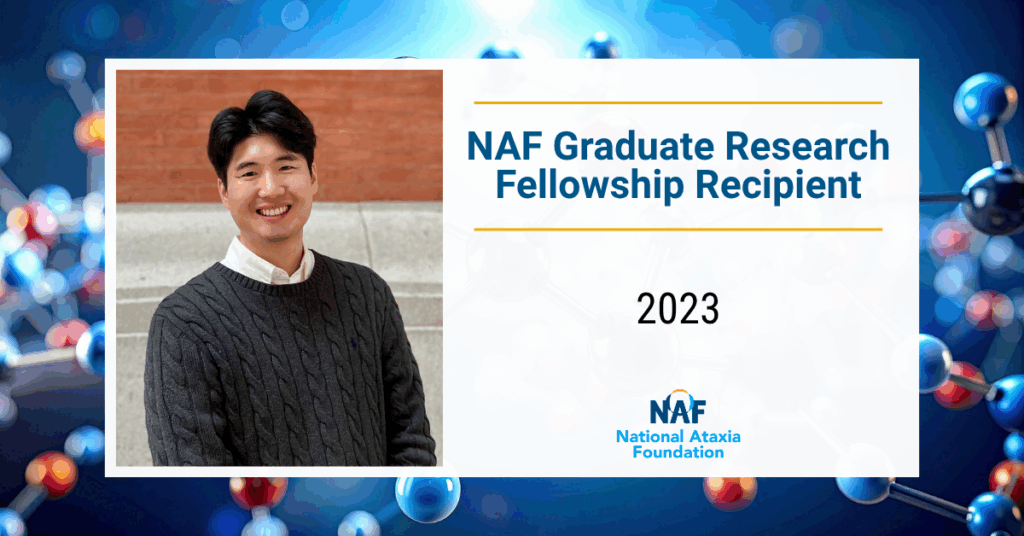
Written by Taylor Stolberg
Faces of Ataxia Research highlights scientists whose work is supported by grants from NAF. Each story shows how our donors are fueling discoveries that bring us closer to effective treatments and a cure for Ataxia.
Meet the Researcher
Project title:
- NAF Graduate Research Fellowship (2023): “Identifying the Role of Oligodendroglia in Spinocerebellar Ataxia type 1 (SCA1) Pathology and Progression”
Education:
B.S., University of California San Diego
PhD, Yale University
Current Position:
- Post-doctoral fellow at Yale University
Path to Ataxia Research
Dr. Lee first became interested in neurodegenerative diseases during his undergraduate research. As an undergrad at the University of California San Diego, he studied the pathology of the neurodegenerative disease amyotrophic lateral sclerosis (ALS) in Dr. Albert La Spada’s lab.
Excited by this line of work, Dr. Lee joined Dr. Janghoo Lim’s lab at Yale University. Here, he began investigating molecular mechanisms underlying Spinocerebellar Ataxia type 1 (SCA1). SCA1 is an ataxia caused by a polyglutamine (polyQ) repeat mutation in the gene ATXN1. This means that a piece of DNA (“CAG”), is repeated more than it should be in this gene. As a result, long stretches of glutamine are produced.
Dr. Lee studies how dysfunction of a specific type of brain cell, oligodendrocytes, contributes to progression of SCA1 pathology and symptoms. He likes studying this work, as Dr. Lee believes investigating the pathology of Ataxias such as SCA1 can be a gateway to understanding related diseases. As he recently defended his PhD thesis, Dr. Lee is now a postdoctoral fellow in the same lab and hopes to continue researching SCA1.
Focus of Current Research
Currently, Dr. Lee is researching brain cell (neuronal) mechanisms driving Spinocerebellar Ataxia type 1 (SCA1) pathology. He is interested in how oligodendrocyte dysfunction contributes to disease progression in SCA1.
Oligodendrocytes are a type of protective cell in the nervous system that produces a substance known as myelin. Myelin is a fatty substance that coats axons of neurons, where it primarily speeds up neuron communication and acts as insulators for the brain cells. As an analogy, the myelin is akin to the rubber coating on an electrical wire. Without this rubber coating, the electrical current cannot flow properly to the rest of the wire. Thus the circuit would be damaged.
Dr. Lee is interested in how mutations in the protein causing SCA1 (ataxin-1) within oligodendrocytes, drive ataxia. Ataxin-1 mutations in oligodendrocytes alone have been shown to contribute to symptoms of SCA1, but how this happens is not yet known. Using a genetically modified mouse model containing a human version of a polyQ-expanded ataxin-1 mutation, and cellular transcriptomic studies, Dr. Lee assesses how the ataxin-1 mutation in these cells leads to the pathology and symptoms shown in SCA1.
This research is important for two reasons. First, knowing how different cells in the brain are affected by ataxia is useful for a deeper understanding of how these cells communicate as ataxia progresses.Second, this data can help identify whether these cells could be potential therapeutic targets. Ultimately, this work will allow Dr. Lee to determine how SCA1 starts and track the progression of the disease. Dr. Lee is also interested in researching other diseases that share a similar mutation type as SCA1, such as Spinal and Bulbar Muscular Atrophy, another disease caused by polyglutamine expansion.
Why Ataxia Research Matters
When posed this question, Dr. Lee described studying ataxia as more straightforward to study than other types of neurodegeneration. SCA1 is caused by one specific mutation. Since the cause is known, he believes researchers can focus on fixing the cause more easily. The causes of other neurodegenerative diseases, such as Parkinson’s Disease or Alzheimer’s Disease, aren’t well understood. This makes researching these diseases more complicated.
Initially, Dr. Lee was first motivated to study neurodegenerative diseases after watching his grandparents experience symptoms of neurodegeneration. From both NAF and his research lab, he has learned more about the clinical hallmarks of SCA1 and how this disease affects everyday patients. Through reading the NAF newsletters and interacting with the ataxia community at conferences, these experiences have given Dr. Lee a personal attachment to ataxia.
Research Impact on the Ataxia Community
Dr. Lee hopes that this basic science research could be translated into therapeutics for patients in the future. Currently, there are limited treatment options available for ataxians. Dr. Lee shared that the more we know about the underlying pathology of the disease, the greater the variety of therapeutic targets could be designed to cure ataxia.
Advancements through NAF Funding
Dr. Lee has learned both academically and personally from this research. Currently, he has a paper ‘in review’ on his SCA1 work. This means that it is currently being reviewed by other ataxia research experts, who will provide feedback on the paper. Dr. Lee will have the opportunity to incorporate the feedback into the study, after which it will be published.
Overall, Dr. Lee has learned that oligodendrocytes are a crucial contributor to SCA1 pathogenesis. This is a research direction he would like to continue studying in the future. Additionally, Dr. Lee recognizes the importance of connecting patients to the research done in the lab. This was one reason why Dr. Lee describes he was excited to do this interview, as he wants to teach patients and the ataxia community members about the ongoing research done for the field of ataxia.
Bridging Gaps in Knowledge
Dr. Lee believes understanding how oligodendrocytes contribute to SCA1 symptoms and disease progression is important for designing new treatments aimed at curing ataxia. To create effective treatments for patients, it is important to decipher how the mutant ataxin-1 affects cells in the brain. Dr. Lee has a paper in revision to a journal on his work, but states he wants to remain in the field of ataxia.
Career Growth Through NAF Support
Receiving the NAF grant has initiated a long-term interest in studying ataxia for Dr. Lee. He hopes to continue similar lines of work from his graduate studies. Due to his connection to the ataxia community and interest in the work, Dr. Lee aims to study SCA1 long-term.
Long-Term Goals
Ultimately, Dr. Lee seeks to translate the science in the lab into clinical treatments for patients. He is deciding between a career in academic or industry research. Academia means conducting research and teaching at a university or college. People in academia can generate new knowledge about a disease, or identify the biology of a disease. An industry career involves doing research for a company, such as Johnson and Johnson or Biogen. These companies apply science research for designing new treatments or products. Dr. Lee is excited to create a better understanding of ataxias. He hopes to use his research to have a scientific impact on the field.
Hobbies Outside the Lab
Dr. Lee really enjoys cooking. He likes to try dishes in different cuisines, such as Korean food. Dr. Lee also enjoys playing tennis, and is starting to learn golf.
Read Other Faces of Ataxia Features
Read Our Latest Blogs