
Written by Taylor Stolberg
Faces of Ataxia Research highlights scientists whose work is supported by grants from NAF. Each story shows how our donors are fueling discoveries that bring us closer to effective treatments and a cure for Ataxia.
Meet the Researcher
Project title:
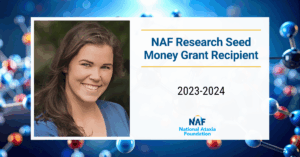
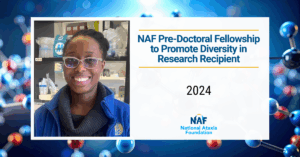
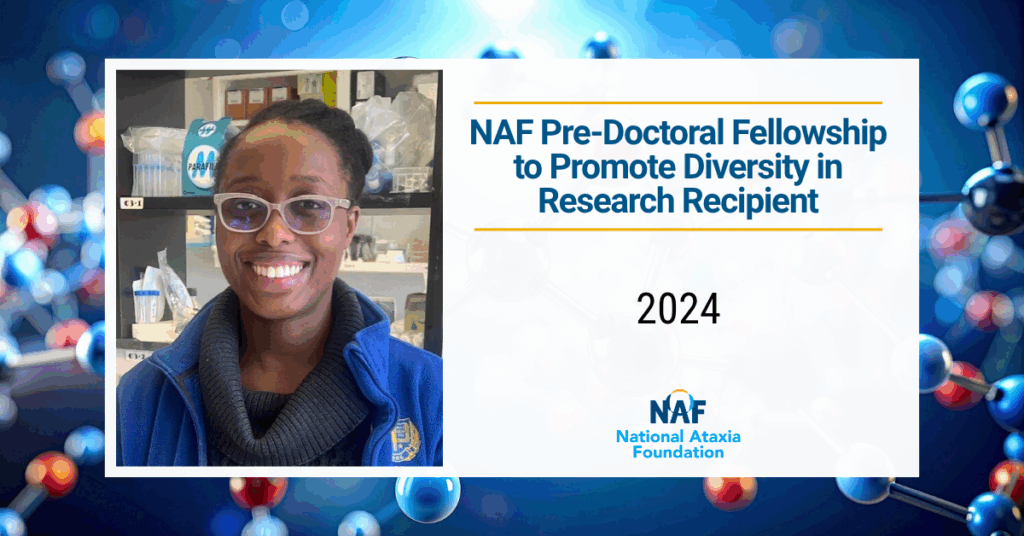
- Pre-Doctoral Fellowship to Promote Diversity in Research (2024): “PUMILIO2 Deficiency: understanding a new ataxia gene and its role in cerebellar dysfunction in mice”
Education:
- B.S., Suffolk University, Biochemistry
Current Position:
- PhD student at Columbia University
Path to Ataxia Research
Sabrina’s interest in ataxia grew from her interest in genetics research. As an undergraduate at Suffolk University, she conducted biochemical research studying FHD (Fumarate hydratase deficiency); it is a rare inherited metabolic disorder that’s caused by mutations in the FH gene. This project piqued her interest in genetics and led Sabrina to work as a research tech in a genetics lab at Brigham and Women’s Hospital after her undergrad, investigating transcription factors and DNA regulatory elements.
When Sabrina went to graduate school, she joined a research lab studying protein dynamics in Spinocerebellar ataxia type 47 (SCA47). SCA47 is a rare subtype of ataxia that causes a mutation in the RNA-binding protein PUM1. Sabrina was very fascinated to learn how many different mutations in RNA could lead to ataxia. Amazed by this, Sabrina wanted to continue studying ataxia in this research lab. She is now a fifth-year PhD candidate in genetics at Columbia University, excited to continue studying RNA and protein dysfunction in SCA47.
Focus of Current Research
Currently, Sabrina studies how different gene mutations contribute to ataxia. Specifically, she studies how the gene PUM2. She studies the haploinsufficiency of PUM2 can cause ataxia-like neurodevelopment disorder. To study the deficiency of PUM2, Sabrina runs behavior experiments on a genetic mouse model to better understand the symptoms caused by PUM2 mutations. She specifically runs behavioral tasks that assess balance and strength, including the inverted hanging tests and the balance beam test.
Currently, it is known that PUM2, an RNA-binding protein, inhibits translation and promotes mRNA degradation of its targets. Sabrina is exploring how PUM2 interacts with other proteins, such as PUM1, in different areas of the brain.
Why Ataxia Research Matters
Sabrina believes investigating mechanisms contributing to SCA is important, both for the disease progression and therapeutically. Two diseases might be distinct from each other, yet are caused by different mutations in the same gene. Sabrina emphasized that knowing how the mutations affect the function of the RNA-binding proteins can help us understand why patients have different clinical symptoms in a disease.
Additionally, Sabrina also expressed the importance of using this research to eventually identify a therapeutic approach for ataxia. To study a treatment for a genetic disease, scientists need to first identify what is the cause of this disease. This is often a gene. Then, scientists need to understand what this gene’s normal function is, and how the mutation disrupts this function.
By knowing what a gene is “supposed” to do, we can better design therapeutics to target a disease. In Sabrina’s work, she is excited to learn about PUM2 because this project can uncover how another PUM protein could be associated with a different spinocerebellar ataxia.
Research Impact on the Ataxia Community
Sabrina’s work can have both educational and potential therapeutic impacts. Firstly, Sabrina hopes to use her research to teach others about the science behind SCA. To treat a disease effectively, we need to know how the disease occurs.
For instance, in SCA47, patients can have the same mutation but different ataxia symptoms. This can make treating SCA47 and similar subtypes more difficult for each patient. Knowing how the mutations contribute differently to ataxia, can help clinicians identify treatments uniquely aimed at each patient’s symptoms. This is not only helpful for better classifying separate ataxias, but could result in personalized medicines for patients in the future.
Advancements through NAF Funding
Through this project, Sabrina gained a lot of knowledge on the physiology of ataxia and neurobiology. When she started this project, she gained a lot of knowledge about how the cerebellum functioned normally and in spinocerebellar ataxia. She describes one thing she loves about the field of ataxia, was that she was always learning something new.
Secondly, Sabrina has also learned about finishing the project and seeing it to a conclusion. Currently, Sabrina is preparing to publish a paper on her research funded by her NAF grant.
Bridging Gaps in Knowledge
PUM2 is an RNA-binding protein from the PUF family that has a highly conserved RNA-binding domain. PUM2 is known for regulating membrane excitability and synaptic function. Sabrina found patients with PUM2 mutations who are experiencing similar and distinct symptoms of SCA47. However, it is unclear how mutations in PUM2 give rise to ataxia-like symptoms. Sabrina’s research is focused on how these mutations affect neurodevelopment and activity in both humans and murine.
Knowing how PUM2 can potentially cause a neurological disease can teach researchers and ataxia community members how these mutations lead to different symptoms. Additionally, different mutations in PUM1 give rise to two distinct diseases in SCA47: PADDAS and PRCA. It is possible that these two RNA-binding proteins from the PUF family may lead to completely different spinocerebellar ataxia subtypes. This can help us understand how proteins from the same family can give rise to moderate or severe neurodevelopmental and neurodegenerative diseases that have ataxia-like symptoms.
Career Growth Through NAF Support
Receiving her NAF grant has helped Sabrina both academically and professionally. Her grant has helped Sabrina fund this project, and helped her write a second grant to continue her research.
Additionally, Sabrina learned how to write more efficiently, a critical skill she will need for entering the research field. After her PhD, Sabrina hopes to enter academia. A career in academia refers to conducting research in a lab and teaching. An everyday part of an academic’s career is publishing papers and writing research grants to fund one’s work. Receiving her NAF grant taught Sabrina how to write a (winning) research grant, which will help her write more funded grants in the future (and hopefully writing more grants to study ataxia!).
Long-Term Goals
Sabrina ultimately hopes to use her research to educate the community on ataxia and neurobiology. She believes it is important to communicate scientific research to both scientists and non-scientists. During the interview, Sabrina also expressed a strong interest in attending the International Congress on Ataxia Research (ICAR) conference. She is very excited to continue sharing her research with the ataxia community.
Hobbies Outside the Lab
Outside the lab, Sabrina really enjoys kickboxing! She’s been doing this for about 4 years now. She also likes strength training at the gym and reading (she is a big Stephen King fan).
Read Other Faces of Ataxia Features