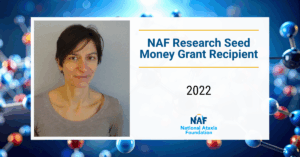


Written by Victoria Martinez
Faces of Ataxia Research highlights scientists whose work is supported by grants from NAF. Each story shows how our donors are fueling discoveries that bring us closer to effective treatments and a cure for Ataxia.
Meet the Researcher
Project title:
Molecular mechanisms and consequences of Purkinje cell vulnerability in SCA1
Education:
- BSc, University of Belgrade
- PhD, University of Illinois
- Post-Doctoral Fellow, Northwestern University
Current Position:
Associate Professor, University of Minnesota Twin Cities, Medical School
Path to Ataxia Research
Dr. Cvetanovic began her scientific journey studying microbiology and physiology at the University of Belgrade in Yugoslavia, now Serbia. She moved to the United States to pursue a PhD in immunology at the University of Illinois, where she studied recognition of apoptotic cells by macrophages. Although she had always been interested in neuroscience, pursuing it was difficult due to the limited availability of programs at the time. She entered the field during her postdoctoral work.
Ataxia became a research focus because it aligned with her interests in neuroscience and allowed her to apply her background in immunology to the study of neurodegenerative diseases. During her postdoctoral work at Northwestern University, she worked with Dr. Puneet Opal, exploring the molecular pathology of Purkinje neurons in a mouse model of Spinocerebellar Ataxia Type 1 (SCA1) She subsequently opened her own lab at the University of Minnesota in 2012 to continue her work on SCA1.
Focus of Current Research
Dr. Cvetanovic’s research focuses on Spinocerebellar Ataxia Type 1 (SCA1), an inherited form of ataxia. She uses mouse models and patient-derived induced pluripotent stem cells (iPSCs) to compare behavioral, motor, and cognitive changes in mice with cellular changes in human models. iPSCs are adult cells that have been reprogrammed to act like stem cells, allowing them to develop into virtually any type of human cell. Because much of what is learned in mice does not always translate directly to humans, Dr. Cvetanovic uses iPSCs to create human cell counterparts, validate mouse findings, and reveal key differences between species.
A particular area of interest for Dr. Cvetanovic is the role of microglia in SCA1 neurodegeneration. Drawing on her background in immunology, she hopes to continue investigating “the immune cells of the brain,” and hopefully discover vulnerable targets for effective therapies. She refers to them as “the immune cells of the brain,” taking advantage of their amenable nature in the lab.
Why Ataxia Research Matters
For Dr. Cvetanovic, ataxia research is deeply meaningful. Through NAF, she has had opportunities to meet patients and families living with ataxia, giving her a firsthand understanding of the devastating nature of progressive diseases. Events such as annual fundraising walks and the ‘Birds of a Feather’ meetings at the Annual Ataxia Conference (AAC) have highlighted the resilience of the community, while also underscoring the urgent need for a cure. Witnessing the toll on families as their loved ones gradually lose essential abilities has left a lasting impression on her and reinforced her commitment to this work.
Dr. Cvetanovic also cites the documentary The Ataxian as a powerful reminder of the daily challenges faced by patients and their families. This connection was made even more personal when she had the chance to meet Kyle Bryant, the film’s central actor, and someone living with Friedrich’s ataxia, at an AIC conference. Friedreich’s ataxia (FA) is a rare, inherited ataxia, usually arising during early adolescent years. FA affects both the heart and nervous system.
Research Impact on the Ataxia Community
Dr. Cvetanovic hopes her research will help in the identification of potential therapeutic targets to slow disease progression in SCA1. Due to the preclinical focus of her work, she aims to provide a foundation for those conducting research at the clinical level, who can translate animal model discoveries into therapies compatible and effective for human patients.
Advancements through NAF Funding
Having received funding from NAF on multiple occasions has allowed Dr. Cvetanovic to gain important insights into SCA1. She studied how inflammation affects the disease and found that astrocytes, a type of support cell in the brain, may help support recovery early in disease progression. Dr. Cvetanovic was also able to explore the protective role of brain-derived neurotrophic factor (BDNF), a protein that supports neuron growth, by injecting it into mice to observe its therapeutic effects.
Today, Dr. Cvetanovic is focused on mapping several different SCA1 symptoms. Because fatal respiratory complications are associated with SCA1, she works with induced pluripotent stem cells (iPSCs) and turns them into cervical motor neurons to study how motor neurons are affected by the disease. Cervical neurons are the nerve cells in the neck that help control muscles for breathing and other vital movements. NAF funding enabled her to generate this preliminary data and establish herself as a researcher, helping her secure additional funding from larger governmental organizations.
Bridging Gaps in Knowledge
Dr. Cvetanovic’s research bridges the gap in current ataxia knowledge by identifying specific brain regions and cell types affected by SCA1. Her work with astrocytes, microglia, and cervical neurons reveals how different cell types contribute to disease and identifies potential targets for therapies. Dr. Cvetanovic’s focus on human and mouse models creates a foundation for other scientists to better understand species differences and navigate the challenges associated with translational medicine.
Career Growth Through NAF Support
Receiving an NAF grant has had a significant impact on Dr. Cvetanovic’s career. When starting a lab, early-career researchers often compete with highly accomplished scientists, including established investigators and even Nobel laureates. The NAF grant provided crucial support for generating preliminary data needed for competitive NIH proposals and helped establish key stages for her lab’s ongoing research.
Long-Term Goals
Dr. Cvetanovic’s overall goal as an ataxia researcher is to make discoveries that can eventually lead to effective therapies for patients. Beyond the lab, she aims to connect with the patient community and communicate that meaningful research is underway, which she believes is important for patients to know. Overall, her broader mission is to continue generating data in hopes of advancing understanding and therapeutic development for SCA1.”
Hobbies Outside the Lab
Outside the lab, Dr. Cvetanovic enjoys exploring the outdoors with her family and her rescue dog, Loie! She is especially excited about her upcoming hiking at Mount Kilimanjaro, the highest mountain in Africa and the tallest free-standing mountain above sea level in the world. Spending time outside helps her recharge and brings a sense of adventure and balance to her busy research life.
Read Other Faces of Ataxia Features