
Written by Victoria Martinez
Faces of Ataxia Research highlights scientists whose work is supported by grants from NAF. Each story shows how our donors are fueling discoveries that bring us closer to effective treatments and a cure for Ataxia.
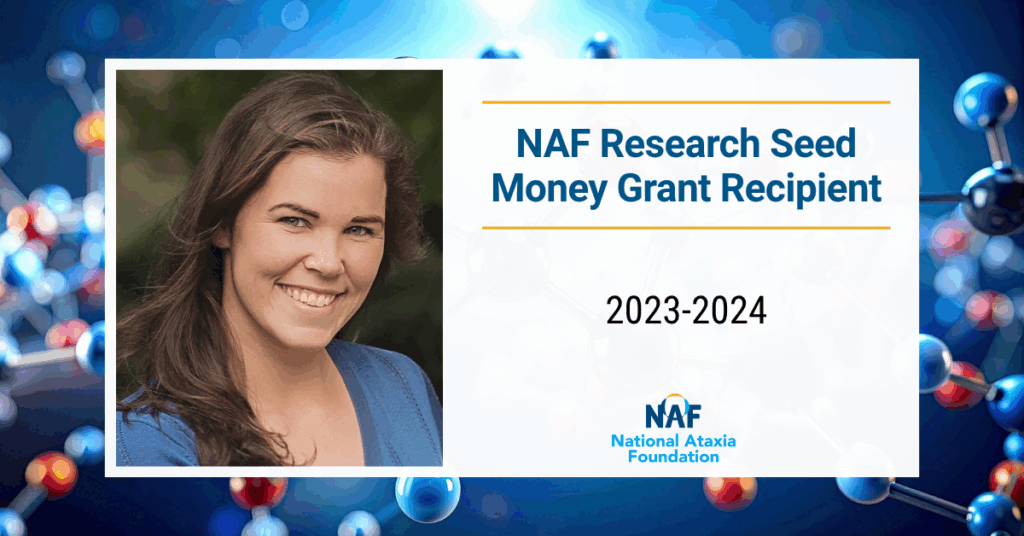
Meet the Researcher
Project titles:
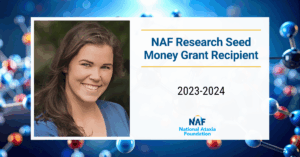
- Research Seed Money Grant (2023-2024): “Mapping longitudinal single-cell transcriptional dynamic vulnerabilities in SCA3 cerebella”
- Young Investigator Award (2017-2018): “Longitudinal Profiling of Spinocerebellar Ataxia Type 3 Mouse Model’s Molecular Signatures and Specific Biomarkers”
Education:
- BSc, Biology and Psychology, Iowa State University (2009)
- PhD, Neuroscience, University of Iowa (2013)
- Post-Doctoral Fellow, University of Michigan (2016)
Current Position:
- Associate Professor of Neurology (tenured) and Human Genetics, University of Michigan
Path to Ataxia Research
Dr. McLoughlin’s path to ataxia research has been shaped by her evolving academic interests. At Iowa State University, Dr. McLoughlin completed a dual degree in Biology and Psychology, immersing herself in both fields while discovering a deep passion for neuroscience. She also became highly engaged in teaching and mentoring, serving as a Biology Supplemental Instructor for many terms and Resident Hall Advisor—experiences that planted the seeds for her later dedication to education.
Keen to delve further into neuroscience, Dr. McLoughlin pursued a PhD in Neuroscience at the University of Iowa. Under the mentorship of Dr. Beverly Davidson, she studied brain development and learned the transformative potential of translational neuroscience, including her first hands-on exposure to ataxia research. Her postdoctoral fellowship at the University of Michigan, in Dr. Hank Paulson’s lab, focused on Spinocerebellar Ataxia Type 3 (SCA3), where she explored gene-targeted therapeutic strategies and deepened her commitment to translating basic research into advanced treatments for patients and their families.
After completing her postdoctoral fellowship, Dr. McLoughlin began her independent career as a faculty member at the University of Michigan. Since joining the university, she has steadily climbed the academic ladder—from her initial faculty appointment in 2016 to her recent promotion as a tenured Associate Professor in the Departments of Neurology and Human Genetics. During this time, she established and now leads a dynamic research laboratory, widely recognized for its innovative contributions to hereditary ataxia research, particularly Spinocerebellar Ataxia Type 3 (SCA3).
Focus of Current Research
The McLoughlin Lab is dedicated to investigating hereditary ataxias, with a primary focus on Spinocerebellar Ataxia Type 3 (SCA3). The lab utilizes mouse models of disease, cell culture, and human tissue and biofluid samples to study disease changes, affected cell populations, disrupted pathways, and alterations in gene regulation and neuronal connectivity. Ultimately, Dr. McLoughlin’s goal is to build a comprehensive understanding of SCA3 and other hereditary ataxias, paving the way for the development of effective and safe therapeutics.
Why Ataxia Research Matters
The experience of engaging directly with patients, feeling genuinely welcomed by the ataxia community, and connecting with fellow researchers in a collaborative field reinforced her commitment to making a difference. She said these interactions continue to inspire her ataxia program and add profound meaning to her research career.
Research Impact on the Ataxia Community
The McLoughlin Lab studies hereditary ataxias to understand how these diseases affect different cells in the body. Dr. McLoughlin is dedicated to developing new therapies that directly address the needs of patients, as well as identifying biomarkers that can help track disease progression and treatment effectiveness. By studying mouse models, cell cultures, and patient tissue samples, the lab can pinpoint which cells and pathways are most impacted by hereditary ataxias. This approach also allows the team to test potential treatments and discover measurable indicators—or biomarkers—that can signal changes in the disease or how well a therapy is working. Together, these advances lay the groundwork for future research, with the goal of bringing effective treatments and better monitoring tools to people living with hereditary ataxias.
Advancements through NAF Funding
NAF funding has been instrumental in advancing Dr. McLoughlin lab’s research on hereditary ataxias, particularly Spinocerebellar Ataxia Type 3 (SCA3). With this support, they highlighted how individual cells play unique roles in disease onset and progression, not only in the cerebellum but also in other vulnerable brain regions affected by ataxia. Through our most recent NAF-supported grant, in collaboration with the Lim Lab at Yale, they applied single-nucleus RNA sequencing to both mouse models and human postmortem tissue. This approach allowed them to identify specific, cell-type molecular changes and new biomarkers connected to disease that they are continuing to study currently in their labs. Overall, NAF support enabled them to gain critical insights into the cellular and molecular mechanisms of ataxia across various brain regions. These advances are helping them to provided better biomarkers and a strong framework for developing new therapeutic strategies for the treatment of hereditary ataxias.
Bridging Gaps in Knowledge
Currently, there’s no FDA-approved drug for SCA3, and so The McLoughlin Lab is seeking to bridge the gap in current ataxia knowledge by providing a detailed understanding of the cells, pathways, and mechanisms affected by the disease for future therapeutic development.
Career Growth Through NAF Support
Receiving NAF funding has had a significant impact on Dr. McLoughlin’s career. It enabled her to gather the preliminary data needed to successfully apply for many larger government grants, such as those from the National Institutes of Health. NAF support has also strengthened her lab, with graduate students Alexa Putka and Juan Mato each securing separate funding that furthers the lab’s research and helps generate valuable new data. Overall, support from the NAF has made it possible for Dr. McLoughlin to grow her research team and advance her work, while also dedicating time to teaching and mentoring the next generation of ataxia researchers.
Long-Term Goals
The long-term objective of my lab is to understand pathogenic mechanisms of hereditary ataxias, so that appropriate biomarkers and disease-slowing therapies targeting the most promising molecular and cellular targets can be developed for these devastating, often fatal, and currently untreatable disorders. Dr. McLoughlin hopes to mentor the next generation of scientists, providing them with the right opportunities, networks, and scientific training to continue research in the field of ataxia and beyond the research bench. This means she is preparing her students for roles such as policy reviewers, industry specialists, academic educators, scientific board members, or other leadership positions that influence research and healthcare decisions. While Dr. McLoughlin’s own work focuses on SCA3 and hereditary ataxias, she aims to ensure that her mentees can apply their skills to other fields, allowing her to have an indirect impact across a broader range of scientific and clinical areas.
Hobbies Outside the Lab
If she isn’t at her kids’ activities or out on walks with her husband, you can usually find Dr. McLoughlin near her power tools, working on her latest woodworking or home improvement project. Her passion for hands-on projects began in childhood, when she helped her dad in his shop—a tradition she now enjoys passing on to her own children. For Dr. McLoughlin, these projects are more than just building—they’re a healthy outlet that help her relieve stress and step away from the noise of daily life.
Read Other Faces of Ataxia Features

Read Our Latest Blogs