
Written by Victoria Martinez
Faces of Ataxia Research highlights scientists whose work is supported by grants from NAF. Each story shows how our donors are fueling discoveries that bring us closer to effective treatments and a cure for Ataxia.
Meet the Researcher
Project title:
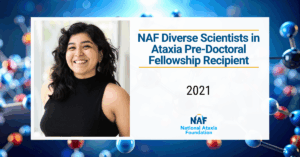
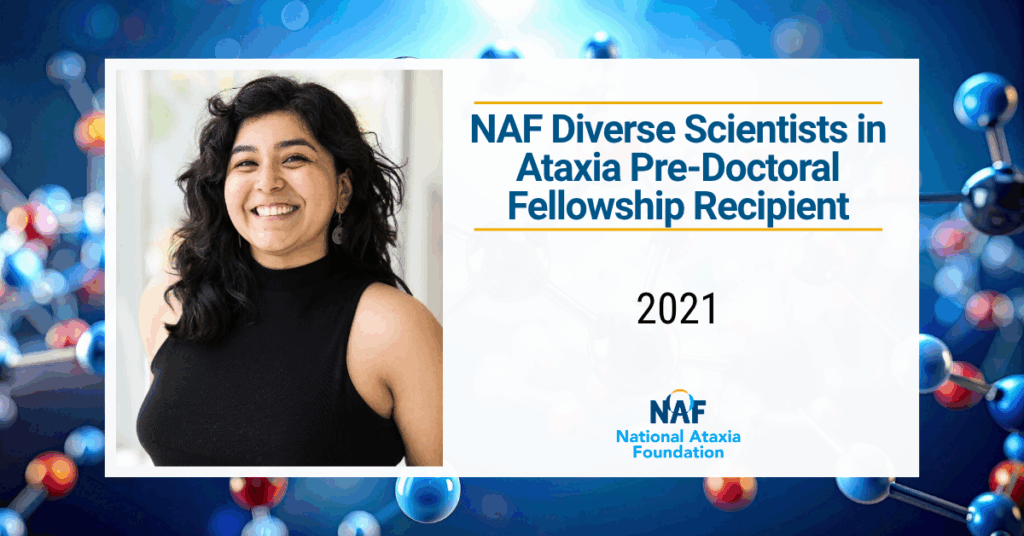
- Diverse Scientists in Ataxia Predoctoral Fellowship (2021): “Uncovering Mechanisms of SNX14- SNX13 Interaction in Cerebellar Function and Disease”
Education:
A.A., Citrus Community College, Psychology
B.S., California State University, Fullerton (CSUF), Psychology
Current Position:
- Neuroscience PhD Candidate at University of Pennsylvania (UPENN), under the supervision of Naiara Akizu, PhD
Path to Ataxia Research
Vanessa’s interest in ataxia originated from her undergraduate research on neurodegeneration. Before arriving at UPENN, Vanessa participated in graduate school preparatory programs, including the Maximizing Access to Research Careers (MARC) and McNair Scholars program. Here, she learned about the process of conducting research and how to apply to graduate school.
At CSUF, Vanessa joined Dr. Math Cuajungco’s lab where she studied the rare childhood neurodegenerative disease Mucolipidosis type IV (MLIV). Vanessa was immediately hooked, as she found it rewarding to study disease mechanisms that could eventually help patients.
Vanessa was excited to continue studying rare diseases for her graduate school work. Now, Vanessa is a Neuroscience PhD candidate in Dr. Naiara Akizu’s lab where she now studies the cellular and molecular mechanisms that underlie the pathology behind childhood cerebellar ataxias.
Focus of Current Research
Currently, Vanessa is researching lipid dysfunction in the neurodevelopmental ataxia Autosomal recessive spinocerebellar ataxia type 20 (SCAR20). She is investigating how loss of the SNX14 gene leads to symptoms of SCAR20.
SNX14 and its paralog, SNX13, are both genes that help control lipid metabolism. Lipids, or fats, are critical molecules in our bodies. Lipids have many roles in our body, including protection for our cells (all body cells have lipids!), neuron survival and function, and play a role in many cell signaling pathways. However, what is not known is how mutations in SNX14 contribute to the pathogenesis of SCAR20.
This is the main question Vanessa’s research is addressing. Using both genetic mouse models and neuronal cell cultures, Vanessa is investigating how the SNX13 and SNX14 proteins interact, and how mutations in SNX13 affect neurons. Surprisingly, Vanessa and Dr. Akizu have uncovered a growing cohort of patients with SNX13 mutations who exhibit similar symptoms to those of SCAR20 patients (caused by mutations in the SNX14 gene).
Vanessa is interested in knowing why these two different genes can lead to ataxia symptoms. Currently, Vanessa is trying to develop the first mouse model of Snx13 in order to study how loss of the Snx13 gene causes cerebellar degeneration and ataxia symptoms.
Why Ataxia Research Matters
Vanessa is motivated to use her research to help others. Since her undergraduate research studying MLIV, she wants to understand how cellular and molecular changes in neurons contribute to disease symptoms, and ultimately, cell death.
Additionally, Vanessa is curious about the cerebellum’s function. During the interview, Vanessa emphasized that our cerebellum has so many important functions for us. However, the cerebellum is understudied. Vanessa hopes to understand why the cerebellum is particularly vulnerable to the loss of function in the two genes, Snx13 and/or Snx14. By understanding why the cerebellum is vulnerable can help us not only understand SCAR20 mechanisms better, but can also apply this knowledge to other cerebellar ataxias.
Research Impact on the Ataxia Community
The genes SNX13 and SNX14, and the proteins they make, are very important for lipid metabolism. These proteins are also critically important for the cerebellum and the rest of the brain. As 60% of our brain is composed of lipids, it is important to know what these lipids do!
However, we do not completely understand how these two proteins affect lipid homeostasis in the brain, let alone neurons. Notably, problems in lipid homeostasis is also found in other ataxia subtypes and neurodegenerative disorders. By investigating the involvement of lipid metabolism genes such as SNX13 and SNX14, scientists can identify specific lipids that are critical for neuronal development, function, and survival. Knowing this lipid involvement can allow scientists and physicians to develop and look for new biomarkers for patients, and potentially earlier and more accurate diagnoses for SCAR20 and related ataxias.
Advancements through NAF Funding
Vanessa gained lots of knowledge on how to study ataxia. In her lab, Vanessa uses many different approaches to study ataxia outside mice and cells, including lipidomics. Lipidomics is a tool that allows scientists to study and characterize many lipids in the body. This gives scientists a bigger idea of which lipids are dysfunctional, and which lipids could be studied for potential mechanisms or therapeutics.
Vanessa is excited to have gained this knowledge to apply towards studying ataxia, a field of research she is interested in remaining in after her PhD. Additionally, she loves the collaboration among the ataxia community! Vanessa described the ataxia research community as very supportive, one of many reasons why she would like to remain in the field.
Bridging Gaps in Knowledge
Lipid metabolism is critical for neurons in the brain. In the cerebellum, lipids are needed for proper cerebellum development and functioning throughout adulthood and beyond. Vanessa’s research investigates how lipids are important for the cerebellum, especially in childhood ataxias, such as SCAR20. For instance, the cerebellum is very vulnerable to damage, especially for ataxia. This means it is possible lipids may affect cerebellar vulnerability, but this needs to be further investigated. As lipid function is not well understood in the brain, Vanessa’s research teaches us how lipids are involved, and how they play a role in ataxia development.
Career Growth Through NAF Support
Receiving her NAF grant has helped Vanessa tremendously! Namely, the NAF grant has enabled Vanessa to progress through studying SCAR20. Vanessa is excited to continue studying lipid metabolism dysfunction from SNX13 and SNX14 mutations.
Secondly, Vanessa has also learned a lot about submitting research grants. Vanessa would like to pursue a career in academia in the future, studying similar research. Academia means a career as a professor, to conduct research and teach classes. People entering academia often write grants to demonstrate their ability to work in academia. Writing and being awarded her NAF grant has also prepared Vanessa to receive the ‘NIH F31 NRSA’. This is a prestigious pre-doctoral fellowship awarded to talented PhD students such as Vanessa to continue making excellent strides in their research.
Long-Term Goals
Ultimately, Vanessa has two aims as an ataxia researcher. Firstly, she hopes to make her science more accessible to the public. She wants her lab research to be more transparent to patients and ataxia community members, and most importantly, to learn about the biology of ataxia. This was one primary reason why Vanessa wanted to do this interview, as she wants to inform the public about her research.
Secondly, Vanessa hopes her work can broaden the research directions in cerebellar research. Proteins are important, but lipids are also important potential drivers of disease. If we know how lipids are dysfunctional in one ataxia, then this can inform others about potential lipid alterations in other ataxias.
Hobbies Outside the Lab
Outside the lab, Vanessa enjoys climbing, exploring the outdoors, and tending to her garden. She loves to try new food, especially Thai and Chinese food. And last but not least, hanging out with her cat Jiji, who Vanessa is very fond of!
Read Other Faces of Ataxia Features