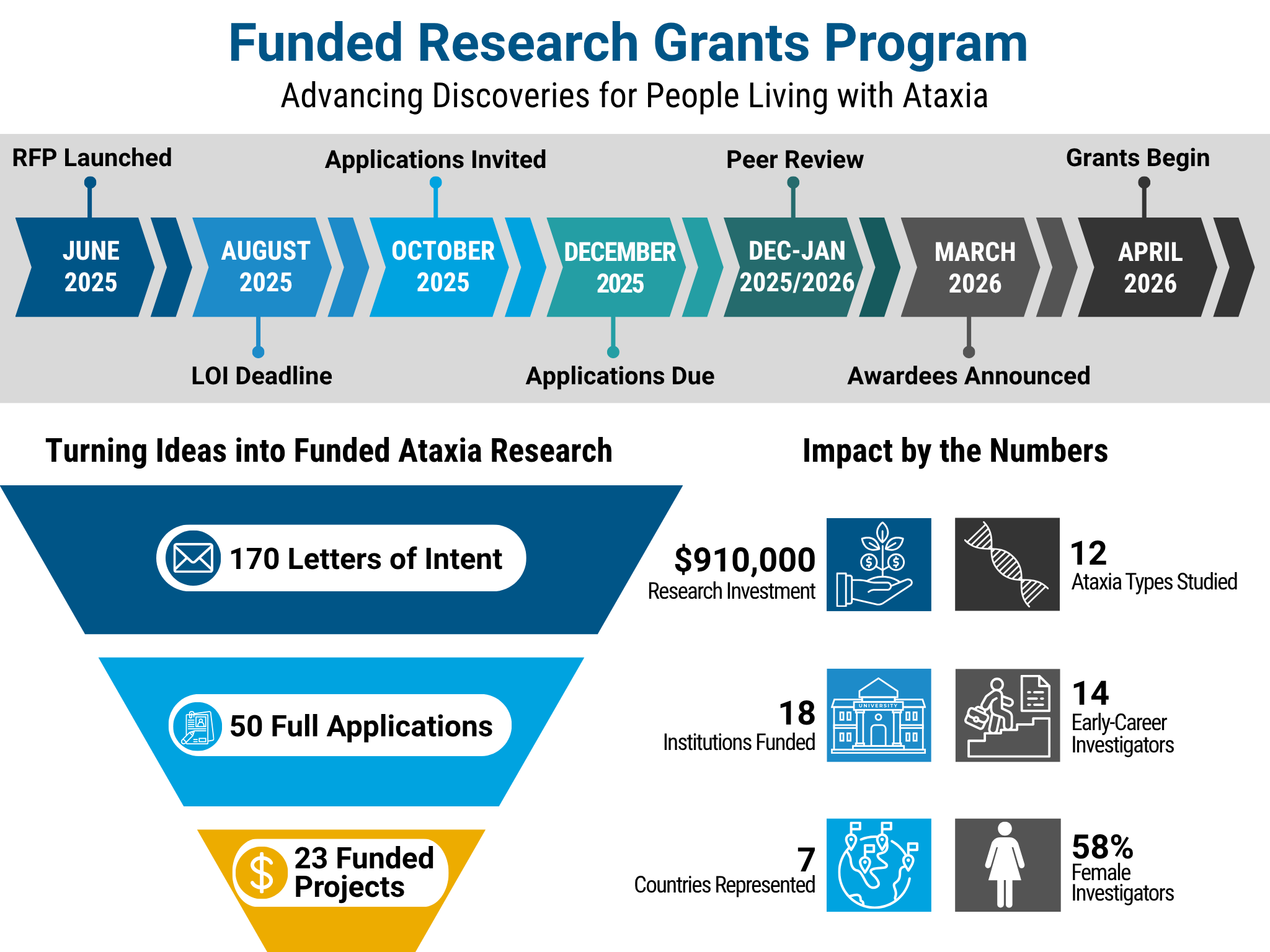
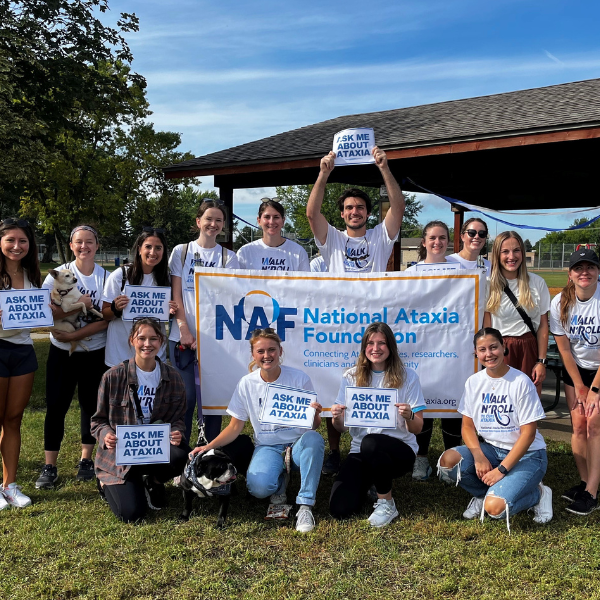
We’re proud to support 23 research grants driving progress in Ataxia research. Explore the full list of funded studies below.
A huge thank you to our scientific reviewers who volunteer their time and expertise to make sure that the best science to accelerate Ataxia treatment development is funded!
For 2026, NAF funded the following research:
NEW this year! 1Michael Lundquist Grant to Advance MSA-C Research – totaling $50,000
8 Research Seed Money Grants – totaling $400,000
4 Early Career Investigator Awards – totaling $200,000
4 Graduate Research Fellowships – totaling $100,000
4 Pre-Doctoral Fellowships to Promote Diversity in Ataxia Research – totaling $200,000
A full list of the research studies and their lay summaries are available below.
Lay Summaries
Research Seed Money Grants
$50,000 – 1-Year Grant
Dr. Esther Becker University of Oxford
Research Title:TRPC3 Modulation as a Therapeutic Strategy for SCA2
Ataxia Type: SCA2
Spinocerebellar ataxia (SCA) is an inherited disease that causes worsening balance and movement problems because key brain cells fail and die. We will test whether reducing the activity of a protein called TRPC3 can protect these cells and improve movement, which may lead to new ataxia treatments.
Dr. Ronald Buijsen Leiden University Medical Center
Research Title:Adaptive Sampling to Unravel Repeat Composition and Identify SNPs for Allele-Specific Targeting in SCA1 and SCA7
Ataxia Type: SCA1 & SCA 7
We are developing a way to tell apart the harmful gene from the healthy gene in individuals with inherited ataxia caused by a dominant mutation. This could help create safer treatments that target only the harmful gene while sparing the healthy one.
Dr. Margit Burmeister The Regents of the University of Michigan
Research Title:FGF14 Intronic GAA Repeats in Vestibular Problems Beyond SCA27B
Ataxia Type: SCA27B
SCA27B is a common form of ataxia caused by a repeat expansion (>250). Here we propose to test whether a population of older individuals with 30-250 repeats, about one in five to one in ten people, is at higher risk of having balance problems in old age.
Dr. Beverly Davidson The Children’s Hospital of Philadelphia
Research Title:Coupling Highly Potent Next Generation Capsids with Base Editing for Platform Gene Therapies for the Spinocerebellar Ataxias
Ataxia Type: SCAs
We will test two gene editing approaches, one which is similar to gene silencing and one which is a completely new method. In summary, we propose to develop and test novel platform methods that can be applied in the future to the treatment of any SCA caused by CAG repeat expansion.
Dr. Chih-Chun Lin Massachusetts General Hospital
Research Title: Defining Purkinje Cell Subtype-Specific Pathways for Motor Control
We are studying Purkinje cells in the cerebellum and how specific subgroups control movement while others modulate non-movement behaviors. We are mapping the brain circuits formed by the movementcontrollingPurkinje cells, which may help guide the development of more targeted therapies for people.
Dr. Michael Lodato University of Massachusetts Medical School
Research Title: Single-Cell Somatic Mutation Analysis in Ataxia Telangiectasia
Ataxia Type: A-T
Our goal is to use cutting-edge DNA sequencing technologies to study DNA damage in Ataxia telangiectasia (AT), a form of ataxia caused by inherited mutations in a gene responsible for protecting the DNA.
Dr. Ricardo Mouro Pinto Massachusetts General Hospital
Research Title: Unraveling the Role of Somatic Repeat Expansions in SCA1 Pathogenesis and Developing Precise Genetic Interventions
Ataxia Type: SCA1
Spinocerebellar Ataxia Type 1 (SCA1) is caused by a DNA repeat in the ATXN1 gene that grows longer in brain cells over time. This project will use SCA1 mouse models to study how repeat expansion drives disease and test a CRISPR gene-editing strategy designed to stop this process.
Dr. Liana Rosenthal Johns Hopkins University School of Medicine
Research Title: Acute Care Utilization as a Factor of Disease Progression
Ataxia Type: Cerebellar Ataxia
We will use Johns Hopkins medical records to find how often and why people with cerebellar ataxia need emergency care or hospitalization. Our goal is to build tracking tools into the records to eventually help prevent these emergencies.
Dr. Sharan Srinivasan The Regents of the University of Michigan
Research Title: Dimethyl Fumarate as a Potential Therapeutic in Spinocerebellar Ataxia
Ataxia Type: SCAs
Spinocerebellar ataxias (SCAs) are rare, incurable inherited brain diseases impairing balance and movement. Our team is testing an already FDA-approved drug, dimethyl fumarate, to understand mechanism and prepare for human clinical trials.
Early Career Investigator Awards
$50,000 – 1-Year Grant
Dr. Sara Duarte Silva University of Minho
Research Title: Targeting SCA3 with Combined Bile Acid and Selective Serotonin Reuptake Inhibitor Intervention
Ataxia Type: SCA3
We study SCA3, a brain disorder that slowly affects patients’ balance and coordination and has no treatment. Two existing medicines improved movement and reduced brain damage in lab models; we are now testing whether combining them can better protect the brain and improve patients’ quality of life.
Dr. Pedro Perdigão University of Coimbra- Centre for Neuroscience and Cell Biology
Research Title: Non-Cell Autonomous Effects in SCA3: Elucidating Astrocyte-Induced Neuronal Dysfunction in a Human Patient-Derived Model
Ataxia Type: SCA3
We are studying a brain disease called SCA3, where a genetic mistake causes a toxic protein to build up and kill neurons. Instead of focusing only on neurons, we want to know whether the brain’s support cells, called astrocytes, are actually making things worse—and if targeting them could lead to new treatments that slow or stop the disease.
Dr. Heather Snell Yale University
Research Title: Manipulation of SK Channel Pathway as a Potential Therapeutic Target in Episodic Ataxias
Ataxia Type: EA2
Episodic Ataxia type 2 causes severe coordination attacks triggered by coffee, stress, or exercise. We found triggers converge on SK2 channel dysfunction. Our research will test SK channel drugs in a new mouse model and patient derived neurons to develop the first treatment to prevent attacks.
Dr. Justin Wolter University of Wisconsin-Madison
Research Title: Characterizing the Proteomic Landscape of Selective Neuronal Vulnerability in ARSACS
Ataxia Type: ARSACS
In many ataxias certain neurons are vulnerable and die while others survive. We will use advanced proteomic technologies to investigate selective neuronal vulnerability in ARSACS, with the goal of discovering protective pathways that could lead to new treatments for ARSACS and related ataxias.
Graduate Research Fellowship
$25,000 – 1-Year Grant
Annabel Devault Yale University
Research Title: Elucidating the Role of TGF-ß-Activated Kinase 1 (TAK1) as a Possible Upstream Regulator of Nemo-Like Kinase (NLK), a Spinocerebellar Ataxia Type 1 (SCA1) Disease Modifier
Ataxia Type: SCA1
I study spinocerebellar ataxia type 1 (SCA1) and am interested in exploring the protein TAK1 as a therapeutic target in SCA1. By using mouse and cellular models of SCA1, I can determine if modifying TAK1 using genetics or drugs can reduce SCA1 disease symptoms and progression.
Monica Ferreira German Center for Neurodegenerative Diseases, Bonn University
Research Title:From Disconnection to Intervention: Ultra-High Field Diffusion MRI of Cerebellar–Brainstem Circuits to Enable Targeted Therapies in SCA3
Ataxia Type: SCA3
This project uses an ultra-high-resolution 7-Tesla MRI scanner to study early changes in the brain pathways that control balance and movement. By examining the brain’s wiring in much greater detail, we aim to identify early and sensitive markers of disease that can be used to track progression.
Maheswaran Kesavan Massachusetts General Hospital
Research Title: Investigating CAG Repeat Instability as a Therapeutic Target in SCA1
Ataxia Type: SCA1
Our research studies “somatic instability,” a process where the CAG repeat expansions that cause Spinocerebellar Ataxia 1 continue to grow after birth, especially in the brain. We aim to test whether this expansion drives the disease and if stopping it could be therapeutic.
Fanny Nobilleau University of Montreal
Research Title: Functional Study of the Molecular Basis of Rare RFC1-Related Disorders
Ataxia Type: CANVAS/RFC1
I’m studying CANVAS, a rare ataxia caused by extra repeated expansions in the RFC1 gene. To understand how it disrupts brain function, I’m generating animal models to mimic the potential pathogenic mechanisms caused by these expansions. My goal is to identify therapeutic targets to develop treatments.
Michael Lundquist Grant to Advance MSA-C Research
$50,000 – 1-Year Grant NEW THIS YEAR
Dr. Woojin Kim University of Sydney
Research Title: A Lipid Pathway for Reducing α-synuclein Toxicity in MSA-C brain
Monounsaturated fatty acids (MUFAs) are elevated in MSA-C brain and promote toxic a-synuclein aggregation. We will define how MUFAs contribute to a-synuclein pathology and identify new targets to reduce their toxicity in MSA-C.
Post-Doctoral Fellowship
$35,000 – 1-Year Grant
Dr. Shiqi Liu Emory University
Research Title: Mechanistic Understanding of ATM Mutation-Induced R-Loop and m6A Dysregulation and its Functional Impact in Ataxia-Telangiectasia
Ataxia Type: A-T
Ataxia-telangiectasia is caused by loss of the ATM protein, which regulates DNA repair. Using patient derived brain models, we will study how ATM loss affects the damage response and changes to RNA at R-loops, structures where RNA temporarily pairs with DNA, and how these changes may neurons. affectneurons. MSA-C.
Pre-Doctoral Fellowship to Promote Diversity in Research
$50,000 – 2-Year Grant
Brazil Bartholomew Yale University
Research Title: Identifying the Contribution of Heterogeneous Purkinje Cell (PC) Subpopulations Toward the Progression of Friedreich’s ataxia and Episodic Ataxia type 2 (EA2)
Ataxia Type: EA2
Ataxias mainly affect the cerebellum causing a wide range of symptoms. To improve personalized treatments, our project investigates how changes in Purkinje cells—the cerebellum’s main output cells—lead to different cognitive and behavioral in models of Friedreich’s Ataxia and Episodic Ataxia type 2.
Alyssa Lyon Virginia Polytechnic Institute and State University
Research Title: Revealing Regional Differences in Cerebellar Spike Entrainment by Neuromodulation in SCA3
Ataxia Type: SCA3
Spinocerebellar ataxia 3 (SCA3) alters the signals that cerebellar neurons use to communicate. We will measure these signals across the cerebellum to identify regional differences at baseline and in response to neural stimulation. Findings will inform best targets for brain stimulation treatments.
Christian Maugee University of Florida
Research Title: Identifying Genetic Modulators of Friedreich’s Ataxia in Cardiomyocytes
Ataxia Type: FA
Friedreich’s ataxia often leads to life-threatening heart disease, but the reasons for this are not fully understood. This project will use advanced gene-editing tools to uncover the genetic factors that influence heart damage in patients.
Caroline Pritchard Research Foundation of SUNY- University at Albany
Research Title: Developing New Tools to Assess Mechanisms Underlying Transcriptomic Signatures of CAG-expansion SCAs
Ataxia Type: SCAs
The pattern of the cell’s RNA genetic messages changes across different Spinocerebellar Ataxias. I’m creating an open-source computer program to find shared RNA patterns across data from people, animals, and cells, to guide new biomarkers, drugs, and technologies for the ataxia community.
How Does the Research Grant Process Work?
To receive an Ataxia research grant from NAF, researchers go through a 4-step process:
Submit a Letter of Intent (LOI) – This is a brief overview that gives information about the goal of their research study.
LOIs are Reviewed – A panel of Ataxia experts review and score each LOI for scientific merit. They determine which LOIs will be invited to submit a grant application.
Submit Grant Application – Studies which received a high enough score to move to the next step of the process are invited to submit a full application. The grant application requires more time and details about their project.
Grants Applications Reviewed and Recommended for Funding – Each application receives 3 separate scientific reviews. NAF has 75 scientific reviewers who evaluate and score each full application that is received. Top-scoring grant applications are recommended for funding.
Thank you to all the researchers who submitted an LOI or application! Keep up the great work that is SO important to the Ataxia community!