
Written by Celeste Suart
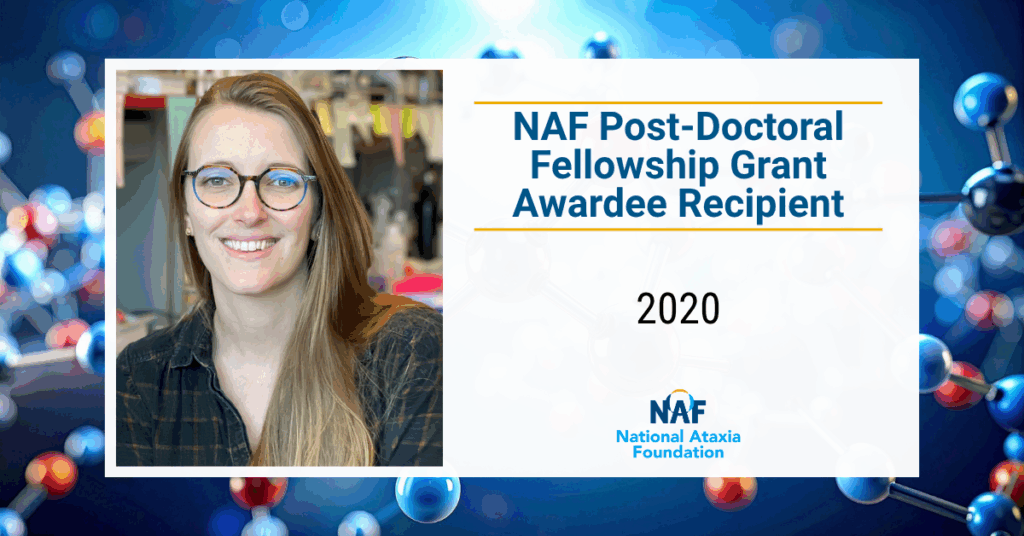
Faces of Ataxia Research highlights scientists whose work is supported by grants from NAF. Each story shows how our donors are fueling discoveries that bring us closer to effective treatments and a cure for Ataxia.
Meet the Researcher
Project title:
A CAG expansion-selective small molecule screen for multiple spinocerebellar ataxias
Education:
- MSci, University College London
- PhD, University of Edinburgh
- Post-Doctoral Fellowship, University of Florida
- Post-Doctoral Fellowship, University at Albany
Current Position:
- Assistant Professor at The University at Albany, SUNY
Path to Ataxia Research
Dr. Shorrock first became interested in neurodegenerative disorders in high school. She had the opportunity to volunteer with a young girl who had a condition caused by an unbalanced chromosome translocation. This led her to learn more about pediatric neurodegenerative conditions during her undergraduate and graduate studies.
At the end of her PhD, she was thinking about her next steps. She had read articles from Dr. Laura Ranum, a prominent ataxia researcher at the University of Florida. Dr. Ranum studies something called repeat-associated non-AUG (RAN) translation, a unique way that proteins are made from repeat expansions. Dr. Shorrock was interested in learning more about RAN translation, so she joined Dr. Ranum’s lab for a post-doctoral fellowship. In the Ranum lab, there were projects focused on Spinocerebellar Ataxia Type 8 (SCA8) and ALS. Hannah decided to focus on the SCA8 project.
Focus of Current Research
Currently, Dr. Shorrock’s laboratory researches small-molecule drugs that regulate RNA expression connected to certain types of spinocerebellar ataxia. She focuses on CAG Repeat disorders, types of ataxia that are caused by similar mutation patterns in different genes. CAG Repeat ataxia disorders include SCA1, SCA2, SCA3, SCA6, SCA7, SCA12 and SCA17.
She hopes to find a small molecule that targets this type of mutation. This type of drug would be helpful for all CAG Repeat disorders, not just one. That way, research into one type of ataxia could be helpful for many. Overall, the Shorrock Lab is very interested in understanding how RNA and RNA expression impact different forms of ataxia. If they can understand what is going wrong with RNA, hopefully, they can fix it.
Why Ataxia Research Matters
Dr. Shorrock began researching ataxia due to intellectual curiosity. Specifically, she was interested in RAN translation. She started studying SCA8 because this is one of the first diseases where RAN translation was identified. However, once she started attending ataxia researcher meetings, she started meeting people with ataxia. She got to know them and their families and the researchers who study these diseases. She also became increasingly aware of the lack of treatment options for ataxias.
Ataxia research is important to Dr. Shorrock because of the connections she has made with Ataxians. She wants to help develop treatment options. Through her research, she wants to serve the community.
Research Impact on the Ataxia Community
Dr. Shorrock’s work is very early stage. Her research helps us better understand how changes in RNA impact different types of ataxia. If we better understand what is wrong, then better treatment options can be developed. Dr. Shorrock also focuses on identifying small-molecule drugs that could be used to treat multiple types of ataxia.
Advancements through NAF Funding
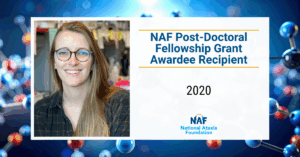
From her 2020 NAF research grant, Dr. Shorrock was able to create a research cell line with 60 CAG repeats. She was able to use this tool to screen for small-molecule drugs that could be used to treat SCA1, SCA2, SCA3, SCA6, SCA7, SCA12, and SCA17. Dr. Shorrock has been able to continue to build on this research in her own lab and she has received funding from the National Institutes of Health (NIH) to expand the range of small-molecule drugs investigated in this system.
Bridging Gaps in Knowledge
Through her work throughout the years, Dr. Shorrock has been able to identify a small-molecule drug that could help regulate RNA expression for certain types of ataxia. A lot more work needs to be done to develop this initial small molecule, but this is a starting point for understanding if regulating RNA expression is a possible therapeutic approach for CAG repeat ataxias.
Career Growth Through NAF Support
It can be hard for international researchers to obtain research funding in the United States as there are a limited number of grant types they are eligible for. Dr. Shorrock is originally from the United Kingdom. Receiving a grant from the NAF helped to kickstart her career. Data generated from the NAF research funding helped her earn other grants from the NIH. These bigger NIH grants helped her set up her lab and become a faculty member. Now she is able to research ataxia long-term because of this stability.
Now, Dr. Shorrock helps to review new NAF grant applications. This is one way to help support the next generation of ataxia science.
Long-Term Goals
Dr. Shorrock’s goal is to contribute to the growing knowledge of the ataxia field in whatever small ways she can. If her research can be built upon by other scientists to help people with ataxia, then Dr. Shorrock will be happy.
One of her interests is in developing treatment options that are affordable. Some types of drugs are very expensive. Compared to other drug types, small-molecule drugs can be more affordable. They can also be easier to access than treatments that require administration by a trained medical professional. This affordability and accessibility are reasons why Dr. Shorrock has focused on this type of research.
Hobbies Outside the Lab
Dr. Shorrock grew up dancing – tap, ballet, jazz, all sorts! She has done it from a young age, and her early volunteer work with the young girl mentioned earlier was at a dance class. Although Dr. Shorrock rarely dances anymore, wherever she has moved, Dr. Shorrock has brought a pair of ballet point shoes with her. She now enjoys cross-stitching, hiking and wild swimming.
Read Other Faces of Ataxia Features
Read Our Latest Blogs