A Wheelchair is Not The Endgame
By Pinalben “Pinky” Patel
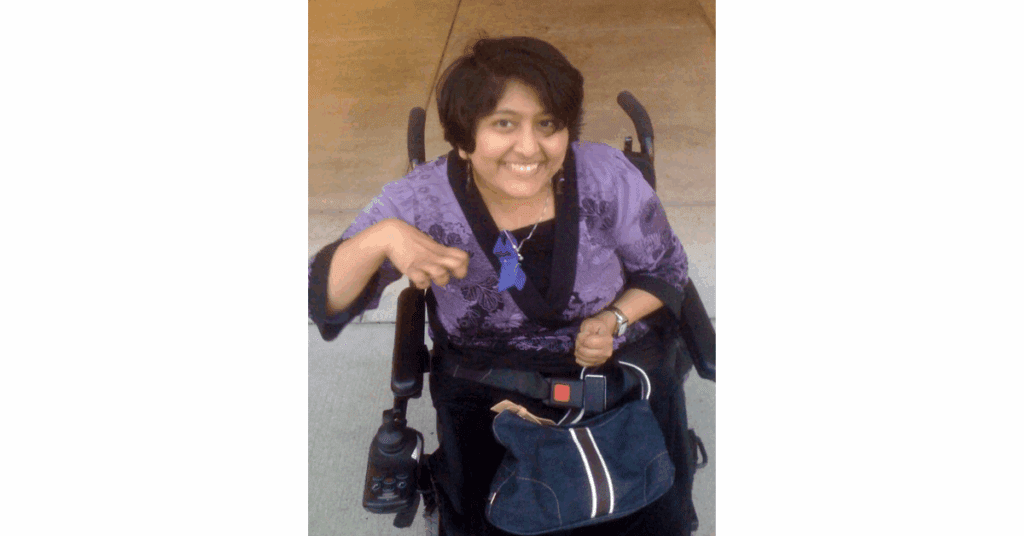
I’m sorry, but I don’t consider wheelchair users disabled. I am a very happy person – there are only a few things I despise in life. And one of them is the comment, “She’s in a wheelchair just like you but she did this and that.”
Looking at me, people thought I didn’t need a power wheelchair and could maneuver a manual wheelchair with my arms. I was diagnosed with Friedreich’s Ataxia (FA), a degenerating neuromuscular disease since I was almost 11 years old, and had been using an electric wheelchair from age 16.
After I began using the power wheelchair, I was able to transfer in an out of it virtually by myself for some years. I was able to bathe, brush my teeth, dress, and take care of my personal hygiene throughout high school.
The beginning of my progression from just wheelchair user to FA-er was in the sophomore year of high school when I was diagnosed with insulin-dependent diabetes. Another FA symptom the doctors found while I had been at the hospital was the thickening of my heart walls, and so I began taking a pill once a day for that, too.
Two years later, I fainted at school, and had another ER visit. The trip turned out to be also due to FA. When I got to the hospital, the doctors found I had Bradycardia (slow heartbeat) and needed a pacemaker implanted to regulate my heartbeat…
I started college in the fall after high school graduation, but I also started needing help in all my personal-care from that time. People wondered why I drove my wheelchair so drunken-like, why I didn’t transfer myself to and from my wheelchair, or why I couldn’t dress and bathe myself like other wheelchair-users.
Of course, those comparing queries aggravated me, but I kept the anger in my mind. Instead of raging at the askers, I calmly educated them about FA. I found that I prefer their questions to them forming conclusions of laziness or petulance.
I applauded them for their willingness to learn about me. They were not asking to be rude; they were just uninformed about my condition. There are so many different disabilities out there, and every one can’t know about every disability. I can only imagine how boring the world would be if everyone knew about everything.
During the last years of high school, I developed a hearing problem. I was able to hear fine when I only had to listen to one person speaking, such as in classrooms and one-to-one conversations. My friends teased me about this problem. They said that I only listened to what I wanted to hear; and I remember getting annoyed at their taunting. I never liked being mocked for my disability, but I did not know that this problem was related to FA. Since I did not know, I couldn’t expect my friends without FA to understand. Thus, I endured their jokes with a smile even throughout the four years of college.
While looking for a job after college, I began to go to support groups about FA and related diseases online. I finally found out the reason of my hearing problem in those groups — it is called Auditory Neuropathy (AN). It happens to many people with FA, and it basically means I cannot hear well on the phone and any situation where there are two noises or more occurring at once.
I also never knew my weakened eyesight was the cause of FA until I met others in my situation online. I saw many wheelchair users and non-wheelchair users wear glasses like I did. But even after LASIK I had shaky vision, depth perception, and needed to wear prescriptions when I wanted to see things clearly from a couple feet.
Nowadays, I can’t drive my power chair, and my scoliosis and curling fingers are more prominent. My vision is 20/2500 and getting worse. But that doesn’t embarrass me in public or keep me from mingling with fellow able-bodied writers.
Some wheelchair users can stand or take a couple steps. Being in a wheelchair is not the same for all wheelchair users. It is not even the same for every person with FA and related diseases. I am lucky to have friends from school (who stopped teasing me after I explained about the AN) and my support groups.
I don’t care what strangers or distant relatives think of me. Although I want to scornfully say you can’t judge a book by its cover, I would always patiently explain my situation to anyone who asks. They only ask because they care, and realizing that will make you happier than being ignored. Always show your whole self everywhere.