
Skip to content

Bill Nye is back in his lab with NAF and Biogen—breaking down the science of Friedreich Ataxia in a new video series. WATCH NOW

Mouse Models

Targeting protein degradation to alleviate symptoms in MJD

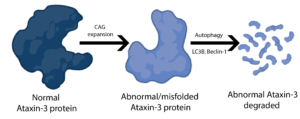
Written by Ambika Tewari   Edited by Brenda Toscano Márquez Trehalose, a natural autophagy inducer shows promise as a therapeutic candidate for MJD/SCA3 Every cell has an elaborate set of surveillance mechanisms to ensure optimal functioning. As proteins are synthesized, errors can occur leading to misfolded proteins. These abnormal proteins can Read More…

A New Use for Old Drugs

Written by Dr. Amy Smith-Dijak Edited by Logan Morrison Basic biology helps identify a new treatment for ataxia Drug design doesn’t always have to start with a blank slate. Sometimes understanding how existing drugs work can help researchers to design new ones, or even to recombine old drugs in new Read More…

Snapshot: What is an action potential?

You may have heard that nerve cells (or neurons) in the brain use electrical activity to communicate with one another. The proteins responsible for creating these electrical signals are called ion channels. How do neurons use these electrical signals to communicate with one another in a meaningful way? A good Read More…

Finding New Off-Balance Protein Networks in SCA7

Written by Frida Niss Edited by Dr. Siddharth Nath Can neurodegeneration in SCA7 in part be due to faulty calcium homeostasis in the cerebellum? Polyglutamine diseases are caused by an increase in the length of CAG repeats within a specific gene. The mutation for spinocerebellar ataxia type 7 (SCA7) was Read More…

The importance of balancing Sacsin protein levels in ARSACS

Written by Dr. Ambika Tewari Edited by Larissa Nitschke Tipping the balance of the protein Sacsin alters outcomes in a mouse model of ARSACS There are many different types of ataxia, each with a unique cause. For several ataxias, the mutated gene that causes the disorder has been identified. This Read More…

Concevoir une stratégie thérapeutique unique pour traiter plusieurs types d’ataxie spinocérébelleuse

Écrit par Dr David Bushart, Édité par Dr Hayley McLoughlin, Traduction française par: L’Association Alatax, Publication initiale: 3 janvier 2020 Une stratégie de traitement nouvellement proposée pourrait être efficace contre plusieurs formes d’ataxie spinocérébelleuse et d’autres troubles associés aux répétitions CAG. Lors de la réception d’un diagnostic initial d’ataxie spinocérébelleuse Read More…

Two or more birds with one stone: Designing a single therapeutic strategy to treat multiple types of spinocerebellar ataxia

Written by Dr. David Bushart Edited by Dr. Hayley McLoughlin A newly-proposed treatment strategy might be effective against several forms of spinocerebellar ataxia and other CAG repeat-associated disorders Upon receiving an initial diagnosis of spinocerebellar ataxia (SCA), a swarm of questions might enter a patient’s mind. Many of these questions Read More…

New Strategy for Reducing Ataxin-1 Levels Shows Promise

Written by Carrie A. Sheeler Edited by Dr. Ronald A.M. Buijsen RNAi reduces levels of disease-causing Ataxin-1 in SCA1 model mice, easing symptoms of disease when injected both before and after symptom onset. Lowering the amount of the disease-causing mutant Ataxin-1 protein in affected cells and tissues improves symptoms of Read More…

Translate »

Join the Ataxia community today!

Become a free member for exclusive content from NAF.