
Written by Victoria Martinez
Faces of Ataxia Research highlights scientists whose work is supported by grants from NAF. Each story shows how our donors are fueling discoveries that bring us closer to effective treatments and a cure for Ataxia.
Meet the Researcher
Project title:
The functional domains of a1ACT and their impact on spinocerebellar ataxia type 6
Education:
B.S., Ohio State University
Current Position:
PhD Candidate at the University of Chicago, under the supervision of Christopher M. Gomez, MD, PhD
Path to Ataxia Research
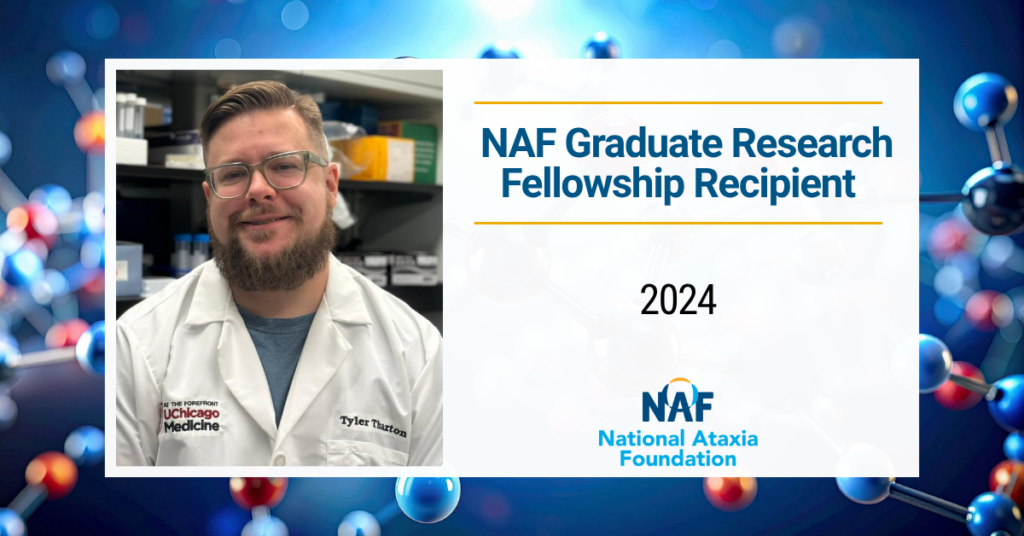
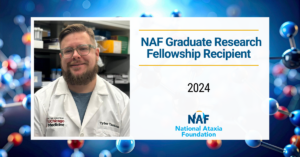
Tyler’s journey began with an interest in psychology and neuroscience as an undergraduate student at Ohio State University, where he joined a clinical psychology lab. Motivated by a desire to explore the brain as an organ beyond clinical psychology and to gain experience in bench research, Tyler took on a laboratory technician position first at Ohio State under Dr. Michele Basso and later, at Northwestern University under the mentorship of Dr. Jennifer Kearney. There, he gained hands-on experience with mouse and cell line models, all while contributing to research on epilepsy, specifically Dravet Syndrome. Dravet syndrome is a serious type of epilepsy, a brain condition that makes children have sudden shaking, staring, or confused spells called seizures. In people with Dravet syndrome, these symptoms start at a very young age. Building on his interest in studying neurodegenerative diseases, Tyler joined the laboratory of Dr. Christopher M. Gomez, MD, PhD, at the University of Chicago. Tyler was drawn to the translational focus of Dr. Gomez’ work during his graduate school rotations.
Focus of Current Research
Tyler is studying the behavior of a protein called the alpha 1 ACT transcription factor (α1ACT). α1ACT is a brain tissue-specific transcription factor, which acts like a light switch to turn the production of specific genes on or off. Tyler works with neural progenitor cells, which are stem cells that can only become neurons and glia, cells that support the function of neurons. This model allows him to study α1ACT in cells that closely resemble those in the brain. Tyler examines how α1ACT binds and interacts with DNA and other proteins and measures its production under healthy conditions to establish a baseline for comparison with its mutant form. He uses a variety of biochemical experiments to characterize the protein’s behavior. Some of these tools include mutating key binding regions to study effects on interactions and viability, as well as assays like Western blotting to measure protein production levels.
Why Ataxia Research Matters
Though Tyler’s initial interest in ataxia was driven by scientific curiosity, he developed a deeper appreciation for the work through the people involved. Due to the translational focus and clinical influence of the Gomez lab, Tyler was able to engage with both researchers and the patient community. He realized that the impact of the disease can extend beyond the patients and to their families. Connecting with patients and their families gave Tyler a sense of meaning and helped him appreciate the significance of his work, as sometimes the intricacy and narrow focus of his research can sometimes feel far removed from the bigger picture.
Research Impact on the Ataxia Community
Tyler hopes that by mapping out the characteristics of α1ACT under healthy conditions: how much protein is made, how it binds to other proteins, and how it interacts in the cell, his work will provide a reference for understanding the protein when it is mutated. This comparison can help researchers determine whether the mutant protein contributes to spinocerebellar ataxia type 6 (SCA6) and help in finding drug targets on the protein, potentially leading to the development of treatments.
Advancements through NAF Funding
Tyler learned that when certain domains of α1ACT are changed or mutated, cells have more trouble dividing, interacting with other proteins, or functioning properly. Proteins are like puzzle pieces that need specific shapes to connect with other proteins; domains are the parts of a puzzle that stick out or are carved out to make those connections possible. If a domain is altered for any reason, the protein cannot do its job or interact with other proteins needed for normal cell function. The research project funded by NAF allowed Tyler to identify those specific functional domains of α1ACT and begin characterizing how each domain contributes to the protein’s interactions, cellular role, and explore its connection to SCA6.
Bridging Gaps in Knowledge
Tyler’s research helps bridge gaps in ataxia knowledge by studying how the normal α1ACT protein works. By examining its behavior, interactions, and function in healthy cells, he can create a robust model to compare against the mutant protein with the polyglutamine mutation. Having a clear picture of the healthy protein is important because it allows scientists to understand how the mutation can cause problems and be implicated in SCA6.
Career Growth Through NAF Support
Receiving a grant from the National Ataxia Foundation (NAF) has had a significant impact on Tyler’s career, especially since it was the first grant he had ever received, instilling confidence in him as a researcher and validating his original ideas. The grant came at a time when funding was already difficult, and even more so for early career researchers in the field. The NAF grant has allowed him to lay the groundwork for future studies and has added credibility to his work, helping him gain recognition and credibility within the research community.
Long-Term Goals
Tyler’s goal as an ataxia researcher is to develop a detailed model of the α1ACT protein by the time he completes his graduate studies. He aims to provide a foundation for future students to build upon, exploring the domains he has identified as potential drug targets. With these targets established, therapeutics could eventually be developed to specifically interact with those domains. He also hopes that future research will investigate the possible connections between SCA6 and the mutant α1ACT protein.
Tyler’s overarching goal is to ensure that both the healthy and disease mechanisms of α1ACT are well understood before therapeutics are developed. By gaining a thorough understanding of the protein and its disease mechanisms, Tyler hopes that future interventions can be more precise and effective.
Hobbies Outside the Lab
Tyler enjoys collecting and playing board games! One of his standout favorites is Brass: Birmingham, an economic strategy game set during England’s Industrial Revolution. In this game, players assume the roles of entrepreneurs aiming to develop industries, build networks, and capitalize on market demands between 1770 and 1870. Players must manage resources, establish connections, and adapt to changing economic conditions to succeed. Tyler enjoys the complex strategy of the game and has a bit of fun trying to bend the rules to outsmart his friends. Beyond his current collection, Tyler is also getting into Dungeons & Dragons, excited to dive into the storytelling and teamwork the game offers.
Read Other Faces of Ataxia Features
Read Our Latest Blogs