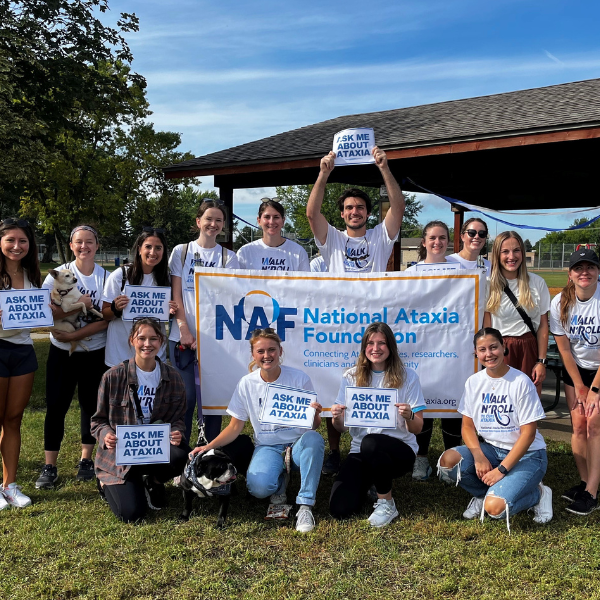


The National Ataxia Foundation (NAF) led a survey of people with Ataxia and their families in January 2025. The goal of the survey was to get feedback on NAF’s services, but also to learn more about the experience of living with Ataxia. In May 2026, NAF staff members published a scientific paper in the journal The Cerebellum, sharing findings from this survey.
What were the results of the survey?
This survey asked people with Ataxia three main questions:
- What is the first symptom you experienced?
- What symptoms do you experience now?
- What single symptom has the biggest impact on your day-to-day life?
Half of people said that poor balance was their first symptom (51%). A quarter said that poor coordination was their first symptom (24%). Coordination included things like moving your arms and legs smoothly or repetitively, but also included smaller coordination tasks like typing on a computer or handwriting.
The NAF community reported a wide variety of symptoms they are currently experiencing. The top three most common symptoms were poor balance (92%), poor coordination (70%), and increased fatigue (70%). Fatigue is the feeling of extreme tiredness or lack of energy.
When forced to choose one symptom that has the biggest impact on daily life, 65% of people surveyed chose impaired balance.
Some differences were found in answers from people with different types of Ataxia. For example, impaired vision was more commonly reported as a first symptom by people with SCA27B than other types of Ataxia.
Responses also differed based on someone’s progression or stage of Ataxia. People with more severe symptoms were more likely to report poor balance as the biggest impact on their lives compared to people with milder symptoms. All data was self-reported. This means that people taking the survey were assessing their own symptom severity (or the symptoms of their loved ones).
This survey was open to all members of the NAF community who have Ataxia or are caregivers to a loved one with Ataxia. Overall, we had 680 participants. This included 587 Ataxians and 93 caregivers. Over half of the participants were women. Most participants (81%) live in the United States. Other countries with large numbers of survey participants included Canada, the United Kingdom, and Australia. The survey was only available in English, which likely limited the participation of NAF members from countries where English isn’t as common.
One thing we hear at NAF a lot is how folks wish that their doctor knew more about Ataxia. It is very common for people with Ataxia to be treated and supported by clinicians who, before meeting this patient, had never seen or spoken to someone with Ataxia. This can be very challenging.
A scientific journal is a publication that shares new, peer-reviewed research findings within specific disciplines or topic areas. These findings are treated by clinicians and researchers as more rigorous or accurate than some other types of reports since the studies are peer-reviewed. Peer review means that before publication, articles are evaluated by independent experts to ensure technical quality, validity, and significance.
When a doctor is unfamiliar with a topic, one of the first things they will do is look for scientific journal articles to learn more. Since Ataxia is rare, there is less information available than for more common disorders like Parkinson Disease or Alzheimer Disease. So, we wanted to share these findings in a scientific journal for two main reasons:
- Increase the overall amount of Ataxia information available through scientific journals
- Specifically increase the information available about Ataxia patients’ preferences and opinions on symptoms. There is even less information available from the perspective of people living with Ataxia.
We also made sure that this study is open access. This means anyone can read the findings. Most of the time scientific journals have paywalls, which make it difficult to access information. We wanted people to learn about the experience of Ataxians no matter where they are in the world.
This is just the first step in sharing information collected during the NAF 2025 community survey. Analyzing this data, writing up the paper, and having it edited through peer review took over a year to do. But this is only the first half of the data. We are now working on a second paper, which focuses on the feedback we got about how people with Ataxia access healthcare. We are currently working on this. We’ll give you an update once it is done.
Read Our Latest Blogs