
Written by Victoria Martinez
Faces of Ataxia Research highlights scientists whose work is supported by grants from NAF. Each story shows how our donors are fueling discoveries that bring us closer to effective treatments and a cure for Ataxia.
Meet the Researcher
Project title:
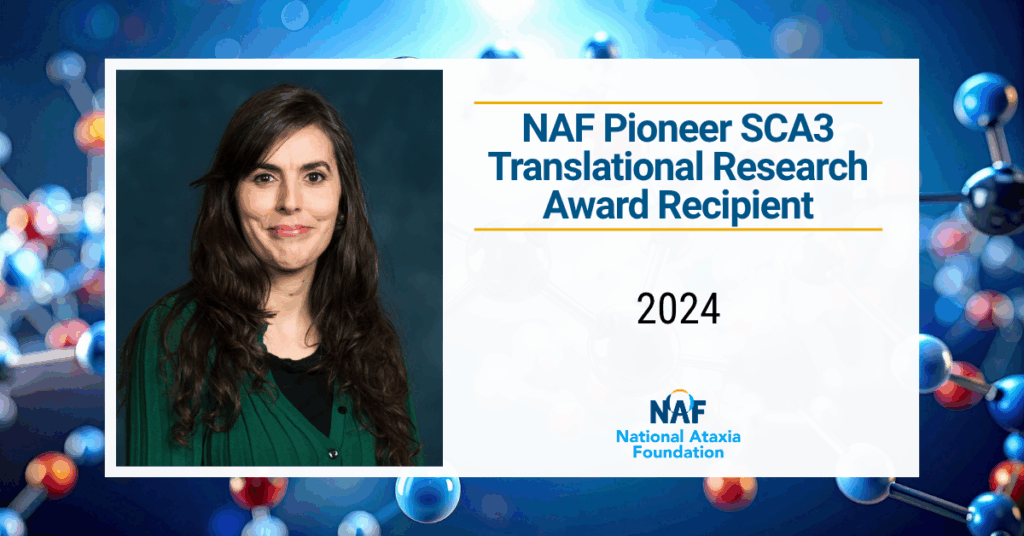
- Pioneer SCA3 Translational Research Award (2024): “Investigating the efficacy of aripiprazole related compounds as a therapeutic option for SCA3”
Education:
Licenciatura in Biochemistry, University of Porto (2000)
PhD, University of Minho (2008)
Post-Doctoral Fellow, University of Michigan (2012)
Current Position:
Assistant Professor – tenure system, Michigan State University
Path to Ataxia Research
Dr. Carmo Costa began her scientific journey at the University of Porto, where a one-year research project, part of her major in Biochemistry, sparked her interest in studying neurodegenerative diseases. From the available projects list, Dr. Costa chose to work on improving the molecular diagnostics of Spinocerebellar Ataxia Type 3 (SCA3) or Machado-Joseph disease (MJD), under the supervision of Dr. Patrícia Maciel, motivated by her interest in human disease-focused research.
The genetic cause of SCA3 had only been identified in 1994, and information about SCA3/MJD was still scarce when Dr. Costa began her work in 1998. Prior to her PhD, she worked as a technician with Dr. Patrícia Maciel and Dr. Jorge Sequeiros, being responsible for conducting accurate molecular diagnoses of Huntington’s disease (HD). Then she continued working with Dr. Maciel as a research assistant on a project to develop animal models for SCA3/MJD.
Dr. Costa began her PhD at the University of Minho under the supervision of Dr. Maciel, here she developed a transgenic mouse model of SCA3/MJD and studied the function of ataxin-3, the protein underlying SCA3. She later moved to the United States, completing a postdoctoral fellowship with Dr. Henry Paulson at the University of Michigan, focused on developing therapeutic strategies for SCA3. She stayed on at the University of Michigan as a research investigator and later as a research assistant professor where she established the Costa Lab. Dr. Costa is now a tenure-track assistant professor, at Michigan State University, where she continues her work on SCA3 research, while mentoring the next generation of scientists.
Focus of Current Research
Dr. Costa’s research mainly focuses on understanding the mechanisms of SCA3 and other polyglutamine diseases to guide drug and target discovery for these diseases. The Costa lab has worked to develop and characterize accurate mouse and cellular models to study disease-relevant pathways. By first elucidating these pathways, the lab has been able to identify and test compounds and other therapeutic agents that could reduce levels of the disease-causing protein and restore cellular function. Overall, the Costa Lab heavily focuses on using an integrated molecular and cell biology approach to identify potential therapeutic targets for SCA3.
Why Ataxia Research Matters
During her time as a technician, Dr. Costa worked closely with a genetic counseling team, where she observed the careful, patient-centered approach to communicating diagnoses. Although she did not have direct patient contact, this experience emphasized the impact that research can have on people’s lives. Researching ataxia is deeply meaningful to Dr. Costa because it allows her to combine her love for molecular genetics with integrated, collaborative research. She is drawn to the complexity of ataxia: the heterogeneity of symptoms and the dynamic, unstable nature of the repeat expansions, but inspired by her mentors’ pioneering work on SCA3, whose passion for the field continues to guide and motivate her.
Research Impact on the Ataxia Community
The Costa lab is testing the efficacy of candidate molecules that can reduce or stop the production of the mutant ataxin-3 protein, responsible for the disease phenotype. This research lays the groundwork for developing treatments that could improve the quality of life for people living with SCA3.
Dr. Costa’s research can have a significant impact on people with ataxia by advancing our understanding of the molecular and cellular mechanisms underlying SCA3. By elucidating the pathways that control the protein’s stability, interactions, and degradation, her work informs potential therapeutic strategies or research that can support the generation of more accurate preclinical models of SCA3.
Advancements through NAF Funding
NAF funding allowed Dr. Costa to complete her postdoctoral training (postdoctoral fellowship in 2011), establish her first independent research pipeline in 2015 (young investigator award), and advance research programs in her lab (Pioneer awards in 2018 and 2024). She developed and implemented assays to identify candidate compounds that could modulate ataxin-3 levels, validated cellular pathogenic mechanisms in SCA3, and generated accurate mouse models that reflect the human disease. Receiving several NAF grants enabled her to establish her independence as a researcher.
Bridging Gaps in Knowledge
When Dr. Costa began her work, there was limited information about the cellular mechanisms underlying SCA3. Her research addresses this gap by elucidating the pathways that control mutant ataxin-3 protein stability, interactions, and degradation. By developing accurate mouse models and cell-based assays, the Costa lab provides detailed insights into disease mechanisms, which can guide the development of SCA3-specific or broad-spectrum therapeutics for polyglutamine repeat diseases and other neurodegenerative proteinopathies.
Career Growth Through NAF Support
Receiving an NAF grant had a major impact on Dr. Costa’s career. It enabled her to establish her own lab and approach her research from several different angles. She can generate preliminary data that serves as the foundation for her ongoing studies, and for securing funding from larger, governmental organizations.
Long-Term Goals
Dr. Costa hopes her research will ultimately contribute to the discovery of SCA3-specific or broad-spectrum therapeutic agents for ataxias. By generating animal models that closely replicate the human disease and testing compounds that reduce or halt production of the mutant protein, she aims to identify treatments that improve the lives of people with ataxia. Even if a therapy is not immediately found, she hopes her work lays the groundwork for future researchers to build upon.
Hobbies Outside the Lab
Outside the lab, Dr. Costa enjoys arts and crafts, gardening, reading, listening music, and spending time with friends and family. She loves painting and jewelry-making, and especially enjoys working with her daughter on pottery projects. When dining out with friends and family, she likes exploring new cuisines, though she avoids spicy foods and lamb. Dr. Costa also enjoys tending her garden, a hobby inspired by her grandparents, who were farmers, and her father, who, although he started as a barber and later became a city bus driver, always kept a garden or small farm where Dr. Costa helped.
Read Other Faces of Ataxia Features
Read Our Latest Blogs